Archive

Author Archives: Guest Contributor

Saveunions

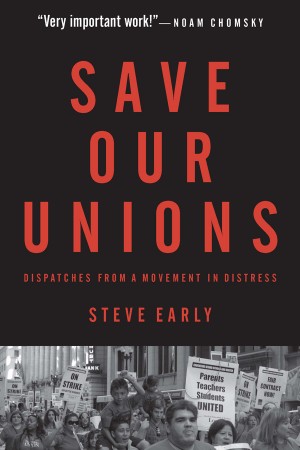
Steve Early. Save Our Unions: Dispatches from a Movement in Distress. Monthly Review Press. February 2014.

Book review by Melanie Simms

Steve Early is a well-known commentator on the complex world of US trade unionism. His analyses are often provocative and always well-informed as he has worked in and around the US labor movement for more than 40 years. This is his third book since he retired from the Communication Workers of America (CWA) union. Evidently he is a man who intends to use the freedom of retirement to stir up debate.

As the subtitle suggests, the book brings together a series of previous pieces he has written for a range of audiences. Typically, they are from the journals, newspapers and websites that cover US labor issues: Labor Notes, Huffington Post, Working In These Times etc. And the tone of the dispatches taken as a whole is distressing. The reader is undoubtedly left with a strong view that the US labor movement is in very deep trouble and that strategies to plot a future course have been ill-fated

Read More

by Noelle Chesley

Mobile-on-a-Boat-Ride

Credit: LexnGer (Creative Commons BY-NC 2.0)

As technology has become an inescapable part of most workplaces, it has become ever more important to understand its impact on employees. Using data from two surveys of U.S. workers, Noelle Chesley examines the effects of both personal and job-related technology use. She finds that increased technology use, especially when it extends work into personal life, is linked with higher levels of worker distress. However, it is also associated with gains in productivity, and personal technology use at work may help employees to manage work-related stress.


Read More

by Erin L. Kelly and Phyllis Moen

Overworked? Overwhelmed? You’re not alone. Seventy percent of employed Americans say work interferes with their non-work lives. Over half feel they don’t have enough time with their children or spouses. This isn’t just one group: it’s mothers, fathers, married workers, singles, Boomers, GenXers and Millennials.

“Work-life balance” has been discussed for 40 years and many companies have tried to address the issue. Seventy-seven percent of workplaces with more than 50 employees allow some employees to change their schedules and 63% allow some regular work to be done at home. Unfortunately, flextime, telecommuting and shifting to part-time hours are usually provided as “accommodations” to help a few employees.

The root problem, of course, isn’t that employees have family or personal commitments. The root problem is the rigid conventions of work that assume work must occur at certain times and places and that mistakenly gauge productivity by the number of hours spent at work.

Read More

by Joan Williams

A recent article in Slate (based on an article in the Guardian) reports that many young Japanese have lost interest in sex. The Japan Family Planning Association found that 45 percent of women aged 16-24, and 25 percent of the men, “were not interested in or despised sexual contact.” A 2011 survey found that 61% of unmarried men and 49% of women aged 18-34 were not in a romantic relationship. A third of Japanese under 30, according to another study, have never dated at all.

What’s the turnoff? Traditional gender roles. “Japan’s punishing corporate world makes it almost impossible for women to combine a career and family,” the Guardian journalist Abigail Haworth writes, “while children are unaffordable unless both parents work.” Nearly 70 percent of Japanese women quit their jobs after their first child, forced out by long hours and hostility toward working mothers, not-so-affectionately called oniyome (“devil wives”).

Read More

by Robin J. Ely and Irene Padavic

Flexible work arrangements are widely championed as remedies for the dearth of women in senior leadership positions. Women “opt-out” when the demands of work and family conflict, so letting them telecommute or work part time facilitates work-life balance, allowing them to stay on the career track. Or so the narrative goes.

In reality, the success of these “family-friendly” policies has been uneven. They are often underused — and for good reason. Research shows that employees who take advantage of “flex” policies are typically removed from the fast track, derailing their career progress. Moreover, these programs have not increased the number of women in senior leadership roles.

Perhaps this is because they do not solve the right problem.

Read More

by Lindsey Trimble O’Connor and Christin L. Munsch

AMC’s hit show Mad Men has received widespread critical acclaim, in part, for its depiction of changing social mores surrounding gender, work, and family. Set in the 1960s, three-martini lunches, overt sexual harassment and stay-at-home wives are the norm. The workplace sure has changed … or has it?

Workplace norms of yesterday were based on a gendered division of labor in which men were breadwinners and women were caretakers. Because women took responsibility for the domestic realm, men could work full-time, without interruption, throughout their lives. With few — if any — disruptions from family life, men were able to put in long hours, on-site, day in and day out. Although these norms were sometimes demanding, workers who complied with them could expect to climb the corporate ladder.

Read More

by Lori Nishiura Mackenzie

The CEOs of Best Buy, Yahoo!, and Hewlett Packard all nixed flexible work policies in response to financial downturns. “During this critical turnaround period, HP needs all hands on deck,” said Hewlett-Packard CEO Meg Whitman. “[T]he more employees we get into the office, the better company we will be.”

In times of economic woe, “non-essential” programs and people are eliminated, and programs to support workers are often ended or drastically scaled back. Employee flexibility is typically considered one of these “luxuries.” In tough markets, employees are supposed to work harder, longer and more devotedly to renew corporate vitality.

Read More