Archive

Author Archives: Guest Contributor

valentino

by Gunn Elisabeth Birkelund, Kristian Heggebø, and Jon Rogstad

People who are unemployed often have difficulties getting back into the labor market, particularly if the unemployment spell is long-lasting. This penalty is called the “scarring effect” of unemployment.

We also know that employers discriminate against ethnic minorities when they apply for a job. It is therefore important to examine how employers react to job applications from unemployed minorities. Long-term unemployment rose in the wake of the 2008 economic crisis, and we wanted to explore if the scarring effects of unemployment were more harmful to ethnic minorities than for the majority.

Our new research explores how employers react to job applications from long-term unemployed ethnic minorities. We compared employers’ response to unemployed minority job applicants with their response to three other groups: employed majority job applicants, unemployed majority job applicants, and employed minority job applicants.

We found that unemployed ethnic minorities received the lowest response of all four groups, whereas majority applicants already at work received the highest callbacks. But our results from a field experiment in Norway show that the penalty for being unemployed was similar for both the majority and the minority group.

Read More

new_office

by Donald Tomaskovic-Devey and Dustin Avent-Holt

Once upon a time, Jim Baron and Bill Bielby told us to bring the firm back in to the study of stratification. After editing a special issue in Research in Social Stratification and Mobility on organizational stratification, we are here to report mission accomplished: the firm is back in.

Increasingly processes assumed on the theoretical level to generate and shape inequality, such as categorization, status expectations, social closure, exploitation, organizational habitus, and social networks, are examined empirically within organizational contexts. The relational turn in sociology has reinforced this move by its insistence on embedding action in relational context.

Using a variety of tools the authors of these pieces illustrate several ways in which organizations shape inequality processes and mechanisms. Authors take up classic stratification questions on declining gender job segregation, growing income inequality, distributive justice, job mobility, and the link between education and income.  However, they each situate the theoretical story underlying these processes within organizations and then examine them with organizational data.

Read More

9954484045_902d51e6b3_z

by Lauren Valentino

It’s an oft-repeated line: “women earn 80 cents for every dollar a man earns.”

Typically, social scientists explain this gap by pointing out the fact that men and women end up in different job sectors. In some versions of the explanation, it is assumed that men and women pick different jobs on the basis of their masculine or feminine preferences. Since feminine-type work pays less, women, on average, earn less.

But why would people choose to go into gender-typical sectors (men into construction, women into teaching), even in today’s society, where substantial – though incomplete – progress has been made toward gender equality? Many social scientists have shown that discrimination is an important part of the answer.

My research suggests that there may also be a “prestige penalty” at play. It is not necessarily that women freely choose “women’s work” and men freely choose “men’s work,” but instead that there are social repercussions to being a man in a “woman’s job,” or a woman in a “man’s job”.

Read More

800px-Bachmann_at_Tea_Party_rally

by Erin A. Cech

In the wake of the election of President Donald J. Trump, social justice efforts and public activism have taken on renewed importance.  Yet conservatives in general and Trump supporters specifically seem to oppose policies and efforts that advance equality for disadvantaged groups.  Popular narratives on the left presume that Trump supporters are more opposed to such social justice efforts because they are more overtly biased toward racial/ethnic minorities, women, and the poor.  But is this accurate?

Although intentional racism, sexism, and classism often anchors opposition to social justice efforts, such overt bias may not be necessary to foster opposition. Belief in a cultural ideology called the meritocratic ideology may be an equally or more important factor than overt bias in Trump supporters’ resistance to social justice efforts.  The meritocratic ideology is a popular belief in the U.S. that frames American society as generally fair and explains lack of success as the result of individual deficiencies in effort and talent.

In a recent study using survey data collected three weeks after the presidential election, I find that Trump supporters are indeed more opposed to social justice efforts than other Americans. But, in contrast to popular liberal narratives, this opposition has much more to do with their adherence to the meritocratic ideology than their overt bias. Trump supporters, in short, tend to be “rugged meritocratists.”

As I discuss, these findings have important implications for equality advocates and scholars. Calls to social action which presume that recipients already agree that structural inequalities pervade U.S. society are likely to speak right past rugged meritocratists. Read More

3311678387_ac76b5c35d_o

by Kim Hoque

Having a union representative in the workplace boosts job quality for employees by reducing their levels of stress, enhancing their job content and improving their work-life balance. These are the central findings of a study I recently published with Unite head of research John Earls and management scholars Neil Conway and Nick Bacon.

The article argues that the impact of onsite union representatives on job quality is important not just for workers but also for employers. In particular, better job quality is closely linked to higher job satisfaction, which in turn has been identified as an important antecedent of higher productivity, increased discretionary effort, lower workplace conflict, fewer quits and lower absenteeism.

The achievement of higher job quality thus has the potential to enhance a range of important socio-economic outcomes.

Read More

alfrey_video_game

by Lauren Alfrey and France Winddance Twine

How do women negotiate male-dominated workplaces of the tech industry? In the February 2017 issue of Gender & Society, we address this question by building upon foundational work on occupational inequality. Inspired by Joan Acker’s concept of inequality regimes, we offer the first qualitative study and intersectional analysis of women tech workers from a wide range of backgrounds. We show how race, class privilege and gender expression shapes the occupational experiences of “geek girls.”

Read More

2017-02-04-15-37-51

by Lara Maestripieri

Economic insecurity is a material condition that includes more than simply having a low income. It indicates a situation in which households have difficulties in autonomously attaining adequate living standards. It thus pertains to how labour-market participation, education and household structure impact on the material and living conditions of individuals in a family.

Women, more than men, are mainly affected by economic insecurity. Although increasing female labour market participation has helped in reducing the general level of poverty risk and economic insecurity of women over the last decade, it has also produced further differentiations among them, exposing women in specific conditions to higher vulnerability.

In a study recently published with my colleagues, Kairi Kasearu and Costanzo Ranci, we surveyed women 20-64 years old in seven European cities, to examine the factors explaining the higher vulnerability of some of them.

Read More

construction_worker_at_westlake_center_1988

by Carolyn Arcand

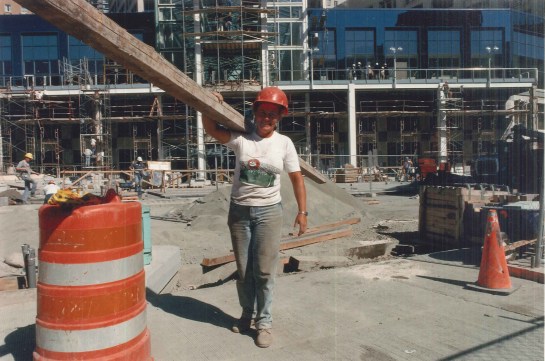
Our society’s ideas about who belongs on a construction site begin at birth. Take a look at the boys’ section of any major infant clothing retailer and you will find onesies and footie pajamas covered with cement trucks and earth movers. These symbols are absent from the clothing designed for baby girls.

Gendered ideas about construction extend to adults in the workplace, where men make up 97.5% of construction workers nationwide.

Construction is a growing sector of the economy that offers relatively high wages, paid on-the-job training for apprentice workers, and often an opportunity to be part of a labor union. Women, who are disproportionately likely to work in low-wage jobs, could benefit from the paid training and high wages provided by construction careers. So, why do women make up such a small segment of workers in this industry?

Prior research, often based on interviews with female construction workers, has sought to address this question. The answer is: it’s complicated. It likely starts in the infants’ section of the clothing store, where the boys are given the outfits printed with construction equipment and the girls are not.

In short, boys and girls are socialized differently.

Read More

sutton-article-image

by April Sutton, Amanda Bosky and Chandra Muller

What should schools teach our nation’s youth? What type of training best prepares all students for labor market success? These questions have fueled contentious academic, political, and public debates for over a century.

While some argue that schools should prepare all students for a college degree, others advocate for a re-emphasis on career and technical training, especially in better-paying blue-collar jobs.

In the policy realm, states in the Rust Belt and Southeast have relaxed academic graduation requirements. Some states allow blue-collar-related training to satisfy math and foreign language requirements. Moreover, alongside his promises to revitalize U.S. manufacturing, President Trump and members of his cabinet have pledged to strengthen career and technical education, dismantle Common Core, and allow local decision-makers to govern what schools teach.

Gender gaps and economic opportunities for women have been glaringly absent from this discourse. This is disconcerting given that blue-collar jobs—some of the few remaining sub-baccalaureate jobs that provide living wages—are highly male-dominated.

What’s more, our estimates show that the small share of millennial women employed in blue-collar jobs earn wages that are only 78% those of their male counterparts.

In a recently published article, we add a gender and spatial perspective to reinvigorated high school training debates.

Read More

working-class-whites-article-feature-imageby Kieran Bezila

One of the puzzles of contemporary voting behavior is why working class voters do not reliably vote for parties of the left that support redistributive measures that would directly benefit them. For example, as Figure 1 shows, one-third to one-half of the American white working class votes Republican, and this is true whether one defines working class by income, education, a combination of the two, or subjective self-identification (the data from the latest election are not yet available).  A common explanation, that moral or cultural values (such as attitudes on immigration, abortion, race, etc.) trump economic concerns, has been the subject of much debate among scholars, without a clear resolution. The vast majority of empirical work done on this question has drawn on survey data.

working-class-whites-article-image

White working class support for Republicans

In new research, we provide a new direction for this debate by changing methods and offering a new argument.

Read More