Archive

Commentary

social-mediaWe–fellow Work in Progress Blogger Adia Harvey Wingfield and I–recently attended a summit centered on Redesigning and Redefining Work. This summit, organized by the Clayman Institute for Gender Research at Stanford University, had lofty goals:  to join academic researchers, government policy makers, members of the media, and company representatives to discuss, among other things, new ways to redesign the world of work so that workplaces can better align—for the long term—with the composition and needs of today’s workforce while at the same time allowing workers and businesses to flourish.

The summit focused, among other things, on how flexible work arrangements have the potential to change work environments in ways that produce greater gender equality. Presenters from corporate and academic sectors considered the ways that these programs have been implemented, barriers to implementation, successes, challenges, and benefits.  The program offered a number of different perspectives on ways that flexible work arrangements can have multiple, expected, and possibly surprising benefits for workers and for corporations.

We wanted to share our personal observations of the summit, whose agenda can be found here, because we feel that sociologists of work should be keyed into the discussion of redesign.  We also think the public should be aware of—and join in via commenting here—work redesign discussions happening in academic, workplace, and policy circles.


Read More

anchormanGlasgow in Scotland is a wonderful city. If it’s puffed neighbour Edinburgh is a city to visit, Glasgow is a city to live in. Before he died in tragic circumstances Scotland’s first First Minister in its new Parliament, Donald Dewar, described it as a handsome city. Indeed in recent years Glasgow has been named UK City of Architecture and Design, and a few years earlier European Capital of Culture. In 2014 it hosts the Commonwealth Games (think summer Olympics for the countries of the old British Empire). It’s all part of the repositioning of a city that was once an industrial heartland for Scotland and that empire.

In recent years that repositioning Read More

Low wage, bad job

Low wage, bad job

It might not have been springtime, but Paris in late autumn is still beautiful. I was invited there to participate in an international conference on the quality of work. Unbeknown to me, my session had been informally labeled by one of our hosts as ‘Bob Dylan vs The Beatles’. The focus was interventions to improve job quality. Bob Dylan was Paul Osterman from MIT. If they were drawing on a Beatle analogy, I was hoping our hosts thought of me as John Lennon and not Paul McCartney: more working class hero than singing frog. The billing though reflects more than our differing US and UK origins; Paul Osterman and I have competing opinions about how to fix job quality and make it better.

Read More

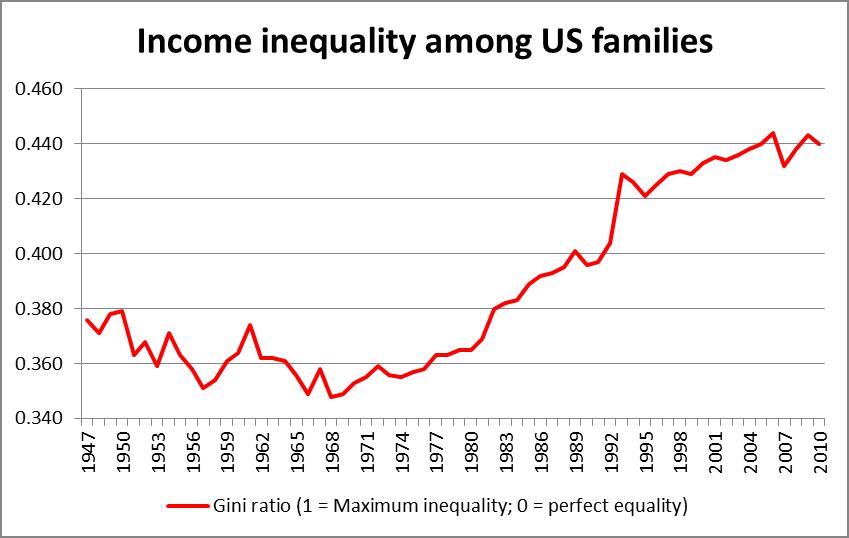
US inequality

Rising income inequality in the United States has become big news over the last few years. Sociology and left political economy have always seen inequality as a structural outcome necessarily produced by the normal operation of capitalist economies. The recent concern shown by mainstream economists and some politicians is more curious, given that – with the exception of a three-year period in the 1990s and again in the 2000s – income inequality has risen steadily from 1968 to the present.

Read More

by Erin L. Kelly and Phyllis Moen

Overworked? Overwhelmed? You’re not alone. Seventy percent of employed Americans say work interferes with their non-work lives. Over half feel they don’t have enough time with their children or spouses. This isn’t just one group: it’s mothers, fathers, married workers, singles, Boomers, GenXers and Millennials.

“Work-life balance” has been discussed for 40 years and many companies have tried to address the issue. Seventy-seven percent of workplaces with more than 50 employees allow some employees to change their schedules and 63% allow some regular work to be done at home. Unfortunately, flextime, telecommuting and shifting to part-time hours are usually provided as “accommodations” to help a few employees.

The root problem, of course, isn’t that employees have family or personal commitments. The root problem is the rigid conventions of work that assume work must occur at certain times and places and that mistakenly gauge productivity by the number of hours spent at work.

Read More

by Joan Williams

A recent article in Slate (based on an article in the Guardian) reports that many young Japanese have lost interest in sex. The Japan Family Planning Association found that 45 percent of women aged 16-24, and 25 percent of the men, “were not interested in or despised sexual contact.” A 2011 survey found that 61% of unmarried men and 49% of women aged 18-34 were not in a romantic relationship. A third of Japanese under 30, according to another study, have never dated at all.

What’s the turnoff? Traditional gender roles. “Japan’s punishing corporate world makes it almost impossible for women to combine a career and family,” the Guardian journalist Abigail Haworth writes, “while children are unaffordable unless both parents work.” Nearly 70 percent of Japanese women quit their jobs after their first child, forced out by long hours and hostility toward working mothers, not-so-affectionately called oniyome (“devil wives”).

Read More

by Robin J. Ely and Irene Padavic

Flexible work arrangements are widely championed as remedies for the dearth of women in senior leadership positions. Women “opt-out” when the demands of work and family conflict, so letting them telecommute or work part time facilitates work-life balance, allowing them to stay on the career track. Or so the narrative goes.

In reality, the success of these “family-friendly” policies has been uneven. They are often underused — and for good reason. Research shows that employees who take advantage of “flex” policies are typically removed from the fast track, derailing their career progress. Moreover, these programs have not increased the number of women in senior leadership roles.

Perhaps this is because they do not solve the right problem.

Read More

by Lindsey Trimble O’Connor and Christin L. Munsch

AMC’s hit show Mad Men has received widespread critical acclaim, in part, for its depiction of changing social mores surrounding gender, work, and family. Set in the 1960s, three-martini lunches, overt sexual harassment and stay-at-home wives are the norm. The workplace sure has changed … or has it?

Workplace norms of yesterday were based on a gendered division of labor in which men were breadwinners and women were caretakers. Because women took responsibility for the domestic realm, men could work full-time, without interruption, throughout their lives. With few — if any — disruptions from family life, men were able to put in long hours, on-site, day in and day out. Although these norms were sometimes demanding, workers who complied with them could expect to climb the corporate ladder.

Read More

by Lori Nishiura Mackenzie

The CEOs of Best Buy, Yahoo!, and Hewlett Packard all nixed flexible work policies in response to financial downturns. “During this critical turnaround period, HP needs all hands on deck,” said Hewlett-Packard CEO Meg Whitman. “[T]he more employees we get into the office, the better company we will be.”

In times of economic woe, “non-essential” programs and people are eliminated, and programs to support workers are often ended or drastically scaled back. Employee flexibility is typically considered one of these “luxuries.” In tough markets, employees are supposed to work harder, longer and more devotedly to renew corporate vitality.

Read More

The early 2000s saw the rise of the yummy mummy. Wholly dedicated to all things baby, bib and bugaboo, but with a yoga-toned body and the latest it-changing bag slung across the shoulder where other mums sported baby puke.

In the last five years, the yummy mummy’s business-minded sister has entered the scene: the mumpreneur. Like the yummy mummy, the mumpreneur is 100% committed to a home-centred version of motherhood. Unlike the yummy mummy, the mumpreneur has not given up her identity as a working woman. But because corporate careers are still difficult to reconcile with baby yoga and toddler swimming she has set up a business that is, literally and metaphorically, closer to home: cupcake decorating classes, personalised bunting, a toy comparison site and a French-speaking nanny agency are just some of the many examples from the business directory on mumpreneuruk.com. Run from home and requiring little start-up investments, such lifestyle businesses are promoted as perfect opportunities for combining motherhood and work.

Read More