Picture1.png

by Michael Sierra-Arévalo

In early 2015, the National President of the Fraternal Order of Police told the President’s Task Force on 21st Century Policing, “now, more than ever, we see our officers in the cross-hairs of these criminals.”

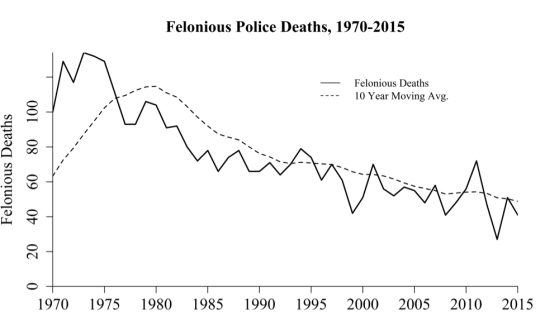
By the end of 2015, officers slain in the line of duty dropped almost 15% from the previous year.
Picture2.png

Even with year-to-year fluctuations in the number of officers feloniously killed (i.e. not accidentally killed), overall trends in the FBI’s Law Enforcement Officers Killed and Assaulted (LEOKA) data suggests a profession that is growing less deadly over time.

Data notwithstanding, the rhetoric of the “war on police” persists in print and on the air, and the perception of a world full of violence that might strike at any moment is alive and well among U.S. police officers.

But though much attention has (rightfully) focused on how hypervigilance or aggressive training and tactics can negatively affect the citizenry, there has been little attention paid to the price officers themselves might pay by being socialized to see their world through violence-tinted glasses.

After spending hundreds of hours with police officers on patrol, at crime scenes, and in training session in three U.S. cities, as well as interviewing nearly 100 officers, I find that police officers engage in behaviors that they believe keep them safe but, in fact, increase the chances of injury and death in the line of duty.


Read More

SONY DSC

by Lena Hipp

What can national governments do to help workers feel secure in their jobs? This question is vital for both individuals and organizations. Workers who believe that their jobs are endangered (even if they actually are not) suffer from poor health and are less happy than workers who feel economically secure; organizations have to deal with decreased loyalty, reduced organizational commitment, and elevated turnover rates.

All of this harms the economy.

Read More

Modern Family - Series 06

by Noelle Chesley

Have you ever noticed what is not “modern” about ABC’s celebrated sitcom Modern Family? Spoiler alert: all of the households in this TV world are headed by a breadwinner father. We get to see a gay couple raising a daughter and a second inter-ethnic marriage with children, but we can’t seem to get rid of the idea that men, and especially fathers, work to support their families while at-home parents (often mothers) do the bulk of caregiving and domestic tasks.

Breadwinning is both an economic arrangement supported through policy (think maternal leave policies) and a gendered social arrangement that pushes men into primary employment and women into primary caregiving roles. While a number of key trends undermine support for breadwinner employment—stagnant wages, increased job instability, and women’s growing educational attainment among them—2013 research by Karen Kramer and her colleagues documents that about 30% of U.S. married couple families with children maintain male-breadwinner households, and this number has held steady for the past two decades.

Social commentators have also noted growing numbers of female breadwinners. In 2013, the Pew Research Center reported that 40% of mothers were breadwinners, up from just 3.5% in 1960.

In a time when work and family arrangements are increasingly diverse, what can the experiences of contemporary breadwinner workers tell us more generally about work, and life outside it, today?

Read More

3001131089_e6a50bd513_o.jpg

by Jacqueline Maria Hagan and Joshua Wassink

Hernando was born and raised in Heredia, a small agricultural community in central Mexico with an established history of emigration to the United States. He left school at the age of eight to help his father farm their land. Seeking adventure he later decided to migrate to the United States, to Georgia where he had friends. There, Hernando found an apprentice position with a master carpenter.

Through observation and informal on-the-job learning, Hernando became a skilled craftsman. After four years of working under the supervision of his mentor, Hernando had saved enough money to return home to Mexico and launch his own woodworking business.

Today he is the proud owner of a woodworking enterprise that provides U.S.-style cabinetry and furniture to the growing return migrant population in his community. Like many other return migrants who launch entrepreneurial activities, Hernando mobilized new technical and social skills acquired in the U.S. labor market to train his employees and carve a new niche in the local Mexican economy, one driven by return migrants who desire U.S. building styles.

Hernando is one of hundreds of thousands of migrants who have returned home to Mexico from the United States since 2010. In a recent study, we investigate the implications of return migration for economic growth and development in Mexico.

While numerous studies have documented a high rate of business formation among return migrants relative to non-migrants, most scholars treat migration as a source of financial capital to invest in businesses upon return home, rather than a pathway to skill learning and transfer. In a recently published study, we explore the relationship between skill formation in the United States and business formation upon return to Mexico.

Read More

1545372225_fef076e533_o

by Ariel C. Avgar, Julie Sadler, Paul Clark and Wonjoon Chung

To what extent can labor-management partnership in the healthcare setting enhance frontline employee voice when it come to the care they provide patients? Evidence supporting the relationship between collaborative labor-management relations and patient care voice would contribute to both scholars and practitioners grappling with the ways in which healthcare organizations can improve a host of important and central outcomes.

In a recent article published in Industrial Relations we attempt to better understand the link between partnership and frontline patient care related voice. Specifically, we argue that partnership is most likely to improve frontline patient care voice in units where the process of implementing this labor-management innovation has been supported by egalitarian and inclusive processes.

We find that where frontline employees report partnership processes that allowed for union and management involvement, mutual respect, information sharing and consensus building, they were also more likely to report greater levels of patient care voice. We also find that the relationship between high quality partnership processes and frontline employee voice is mediated by their trust in management. These finding are important given the current state of healthcare in the United States and in many other countries.

Read More

640px-safety_pin

by Terence E. McDonnell

For many Americans, safety pins have suddenly appeared everywhere: Pinned to shirts, posted to Facebook, or worn by celebrities. When I started wearing one a handful of strangers asked “what the heck are these safety pins all about?” This is the challenge of new symbols. Before they can work people need to know what they mean.

Americans had similar questions in 1991 when celebrities attending the Tony Awards donned red ribbons on their lapels and gowns. In a new paper at Poetics (coauthored with Amy Jonason and Kari Christoffersen) that traces the different trajectories of red AIDS ribbons and pink breast cancer ribbons, we argue that new symbols must be both retrievable (visible and available in the public sphere) and recognizable (people share an understanding of its basic meaning) to have the intended effects. While red ribbons might be publicly available, they can’t effectively raise awareness if they don’t denote “AIDS.”

New symbols often borrow from pre-existing cultural symbols in order to harness their cultural power. The single-looped awareness ribbon is now iconic, but its first instantiation in the red AIDS ribbon intentionally borrowed the ribbon idea from the contemporaneous public practice of using yellow ribbons to denote support for troops in the first Gulf War.

Read More

mentor

by Beth Humberd and Bess Rouse

Mentoring is considered essential to career development.  Yet, study after study shows that not all mentoring relationships are effective: often the protégé does not reap the intended benefits of such relationships; and in many cases, mentors do not feel invested in or connected to the relationship.

On the other hand, there are certainly instances where high-quality mentoring relationships arise; in these relationships, both the protégé and the mentor experience growth and development in personal, professional, and career domains. What, then, can account for these variations in the quality of a mentoring relationship over time?

In our recently published conceptual paper, we theorize how personal identification – the process by which individuals realize cognitive overlap between the self and other over time in a relationship –may be key to fostering higher quality mentoring relationships.

Read More

10895361_a831db15b2_o

by Frederik Thuesen

Words matter crucially to the formation of social relations, particularly in ethnically diverse low-skill workplaces, where native-born workers encounter ethnic minority immigrant workers who may not be fluent in the host country language. Since many of these immigrant workers gain a foothold in the labor market in low-skill workplaces, linguistic barriers in these workplaces often have a profound impact on social relations.

Not surprisingly, many western workplaces—especially low-skill ones—are increasingly becoming ethnically and linguistically diverse from both immigration and the arrival of asylum-seekers from countries such as Afghanistan, Iraq, and Syria.

Read More

1200px-siliconrus-hqby Jennifer Glass

Much has been written recently about the growing earnings premium for workers willing to work long hours, creating a new dimension on which (mostly male) professionals without care responsibilities can distinguish themselves and hoard positions of power and authority within organizations. These findings should be of serious concern to scholars of inequality, as well as those studying new forms of work organization or the persistence of gender stratification in the workplace.

One primary way for groups to hoard resources, of course, is to “move the goalposts” as disadvantaged groups gain leverage in high wage sectors of the economy. The history of racial exclusion is full of such attempts to increase qualifications or transform them so that racial preferences can be kept intact. Long work hours serve the same purpose in excluding workers with family responsibilities and their associated costs (lower availability, greater need for flexibility, etc.) from positions of power and authority.

But recently, my colleague Mary Noonan and I examined the issue in a different way by looking longitudinally within the careers of individuals who are salaried workers to find the premium for overtime work.

Read More

6700507157_256f422db1_b

by Ellis P. Monk, Jr.

This seemingly simple, yet deceptively complex question is at the heart of burgeoning research on the ‘multidimensionality’ of race.  This research attempts to answer this opening question by considering a range of different measures of “race” as a concept – but what are these different dimensions?  And what dimensions seem to matter most when we measure social inequality?

In the United States, for example, many people associate race with ancestry.  This makes sense given the historical legacies of antiquated, purportedly “scientific” theories of race and the persistence of the ‘one-drop rule.’  Following this rule, individuals with ‘any known trace’ of African ancestry are to be classified as black.  Over the course of a few centuries this rule eventually was embraced by whites and non-whites alike resulting in the common folk notion of race that has been dominant in the U.S. for decades.

While it is clear that the population of ‘mixed-race’ individuals has grown tremendously in the United States, recent estimates show that less than 3% of the U.S. population identifies as ‘one or more race.’  Just think of President Barack Obama, whose “mixed” ancestry is well-known, but openly identifies as ‘black’ and, notably, does so on the U.S. census too.

The fact remains that most individuals with African ancestry simply view themselves as black and are viewed by the majority of the people they encounter in their daily lives simply as black.

Read More