glass_blogimage_june-20141by Christy Glass

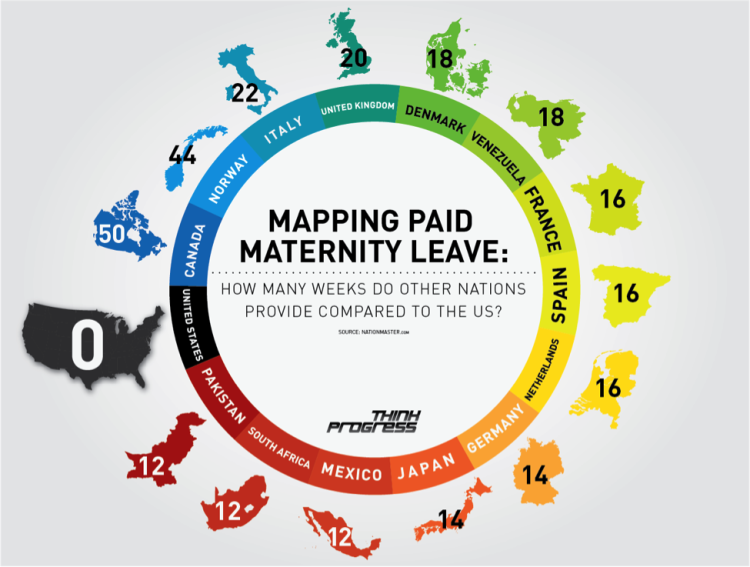
In a recent article published in Forbes (here), business writer Tim Worstall wonders why family-friendly policy advocates support paid maternity leave policies. In his view, such policies are not just ineffective but harmful to women because they damage women’s professional standing—and ultimately reduce their wages. Quoting a woman CEO who shares his views, Worstall argues that mothers should limit their time on paid leave or risk losing the confidence of their employer. So why on earth would anyone argue for more or better paid leave policies?

Read More

work wheelAmong the many things that the American mythology holds to be special about the United States is a particularly strong work ethic. This, of course, is part of a larger narrative of rugged individualism. However dubious the idea of a uniquely American work ethic, it is certainly telling to examine how much Americans work compared with fellow workers in peer countries.

In terms of average annual hours worked per person, the US currently ranks 12th out of 34 OECD countries – that is, Americans work more per year than workers in 22 other OECD countries. The average Dutch worker clocks in 405 fewer hours per year than the average American worker! Yet, the Netherlands ranks ninth out of the 34 countries in GDP per capita, 15% above the OECD average and just five places behind the US. As economist Juliet Schor argued in a best-selling book over 20 years ago, Americans are overworked. Let us examine the most recent, comparative data in a bit more detail.

Read More

Scientific objectivity and the cool assessment of facts are the hallmarks of the science, technology, engineering, and math (STEM) disciplines. So, of course, stereotypes have no place in these research labs and university departments. Or so you might think. But, when evaluating identical resumes, scientists may be significantly less likely to agree to mentor, offer jobs, or recommend equal salaries to a candidate if the name at the top of the resume is Jennifer, rather than John.

Read More

Northeastern University adjuncts organized successfully on their own behalf.

Northeastern University adjuncts organized successfully on their own behalf.

There’s a great deal of discussion about the “corporatization” of the university, or about “academic capitalism,” and the infusion of market logics into higher education. Much of this literature has followed the money and –reasonably enough— emphasized the growing academic effort to capture commercially lucrative knowledge, large public grants, or tuition dollars. I myself have contributed to this literature, however modestly. But because I have also held administrative positions, I have access to at least some inside knowledge about the “corporatization” of the academy. And this more experiential form of data convinces me that the study of higher education has been somewhat one-sided, in that it has ignored important changes in budget and accounting systems within the academy (such as “resource-centered management”), or the spread of marketing and institutional “branding,” which have powerfully infused market logics into many leading American universities. Another issue that warrants much closer attention than it has received is what we might call (however inelegantly) the “adjunctification” of the professoriat.

Read More

wage_theftby Corey Robin

Midterm elections are like fancy software: Experts love them, end-users couldn’t care less. But if the 2010 elections are any indication, we might not want to doze off as we head into the summer months before November. Midterm elections at the state level can have tremendous consequences, especially for low-wage workers. What you don’t know can hurt you — or them.

In 2010, the Republicans won control of the executive and legislative branches in 11 states (there are now more than 20 such states). Inspired by business groups like the American Legislative Exchange Council (ALEC), the U.S. Chamber of Commerce and the National Association of Manufacturers, they proceeded to rewrite the rules of work, passing legislation designed to enhance the position of employers at the expense of employees.

Read More

We are posting a four-part panel today, with five sociologists providing a health check on the sociology of work. Chris Warhurst begins the panel by noting that the inability of mainstream economics to predict or explain the 2007-8 financial crisis might provide an opening for the sociology of work to become more influential. Yet, across the UK and Australia, the study of work has been eclipsed in sociology by cultural and gender studies. Chris wonders if part of the problem is the lack of good ethnographic research by sociologists on knowledge workers like investment bankers.

Read More

Chris Warhurst raises a number of issues that warrant careful attention. One stems from the still-considerable boundary between UK and US sociology – trends “over there” don’t map on to what’s happening in the USA (to the detriment of both sides, I might add). A second and related issue concerns the fate of the sociology of work and employment –empirically rich and ascendant, relative to economics? Or in the doldrums and losing its audience? A third is the jurisdictional struggle between culturally attuned areas of study (cultural studies, gender studies) on the one hand, and more structurally oriented approaches toward the “hidden abode.” Let me comment on these in turn.

Read More

Chris Warhurst takes the 2007-08 financial crisis as a point of departure to ask some important questions. What is the future of the sociology of work? Is there still a place—indeed a need—for those “ethnographic monographs on work and employment” that have long been the backbone of the field?   It was so disheartening to read that new introductory textbooks subsume work within chapters on tourism and sport; while there is “little teaching of the sociology of work and employment in Australia’s top universities.” Yet I don’t think that the problem lies where Warhurst suggests it does, with a dearth of trading floor ethnographies. What we’re confronting is a deeper crisis, what I’ll call a decoupling of work from profits. It is the real culprit behind the marginalization of the sociology of work, and it derives from the financialization of the economy.

Read More