The Rise of the Permanent Temp Economy

By Erin Hatton

(This article was originally published in the New York Times. The original version can be read here: http://opinionator.blogs.nytimes.com/2013/01/26/the-rise-of-the-permanent-temp-economy/?emc=eta1)

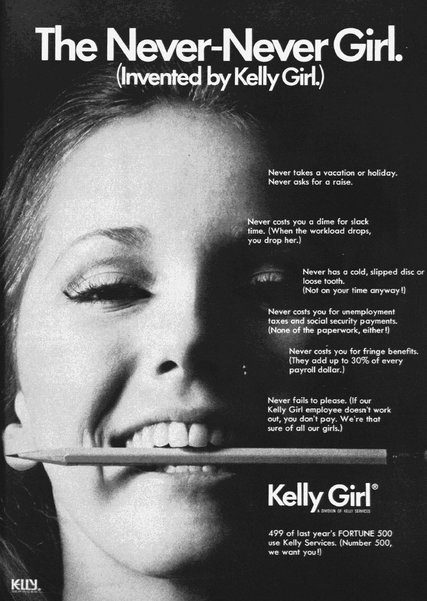
Kelly girl

Politicians across the political spectrum herald “job creation,” but frightfully few of them talk about what kinds of jobs are being created. Yet this clearly matters: According to the Census Bureau, one-third of adults who live in poverty are working but do not earn enough to support themselves and their families.

A quarter of jobs in America pay below the federal poverty line for a family of four ($23,050). Not only are many jobs low-wage, they are also temporary and insecure. Over the last three years, the temp industry added more jobs in the United States than any other, according to the American Staffing Association, the trade group representing temp recruitment agencies, outsourcing specialists and the like.

Low-wage, temporary jobs have become so widespread that they threaten to become the norm. But for some reason this isn’t causing a scandal. At least in the business press, we are more likely to hear plaudits for “lean and mean” companies than angst about the changing nature of work for ordinary Americans.

Read More

Flu Outbreak: Why Paid Sick Days Matter

By Shamus Khan

(This article was originally published on Time.com. The original version can be read here: Read here: http://ideas.time.com/2013/01/22/flu-outbreak-why-paid-sick-days-matter/#ixzz2JBd5yMZo)

We are in the midst of one of the worst flu seasons in recent memory. By the end of it, about 60 million Americans are likely to contact influenza, over 200,000 will probably to be hospitalized and tens of thousands will have died. While we typically look to doctors and medicines in a health crisis, we should recognize that guaranteeing paid sick days to workers could do as much, if not more, to help moderate the impact of influenza and other contagious diseases.

Every other industrialized nation in the world guarantees this right, but very few places in the U.S. do; they include a handful of cities like San Francisco, Milwaukee, Washington and Seattle — and one lone state: Connecticut. What that means is if you live anywhere else in the nation, you can be fired for missing work because of an illness or for caring for a sick family member.

Read More

Lately, I’ve become convinced that those of us who study work organizations have kind of missed the boat. Which boat? I suppose that vessel can best be described as popular culture. Let me explain.

I teach social theory pretty often, and if you do that, you more or less have to come to grips with the relation between power, culture, and social inequality. With me so far?

So. When I put on my sociology of work hat, and read through our various efforts to understand the working out of power, I find it hard not to feel as if this field is culturally deprived. Oh sure, there’s a slew of studies focusing on organizational culture (whatever that means). But very, very little that asks where and how workers acquire the images of work and authority  which they bring with them into their work situations.

It’s as if we’ve missed the “cultural turn” entirely, abandoning the whole field of popular culture to the cultural studies types (most of whom wouldn’t know honest employment if they fell over it).

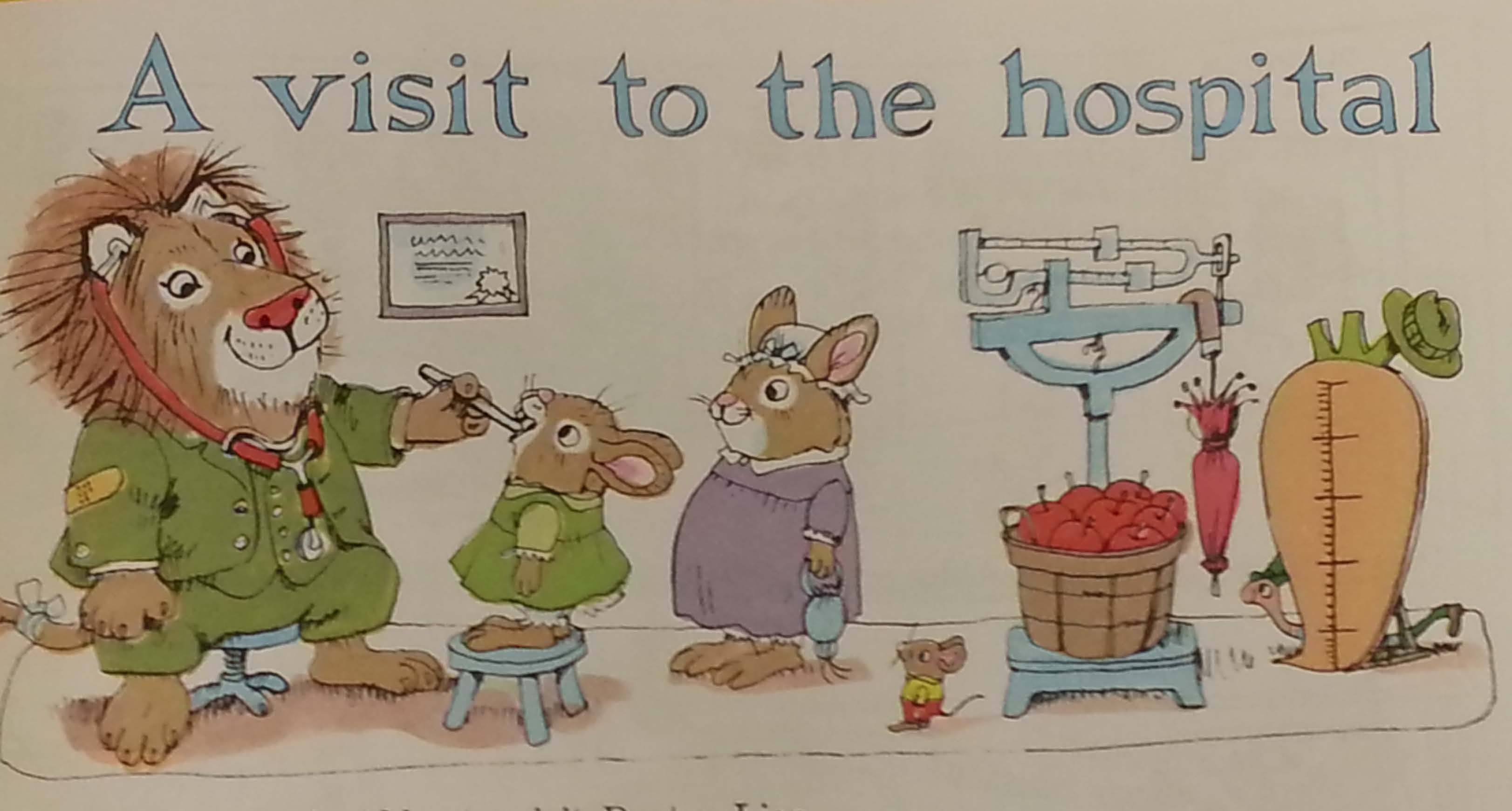
lion as md

Kidding there! But I am serious when I opine that we need to pay much closer attention to media, television, movies, advertising, magazines, and children’s literature.

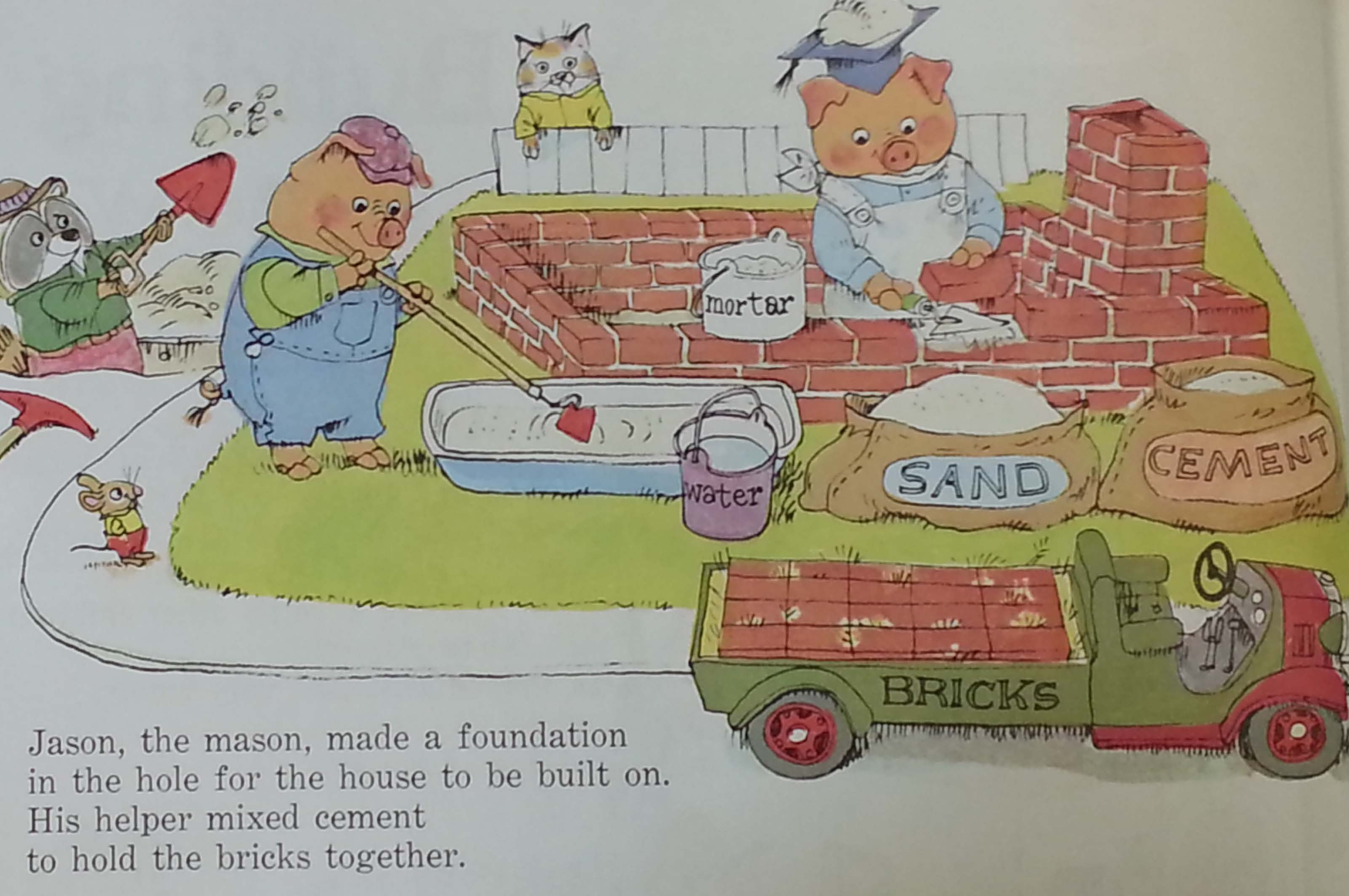
Which brings me to the odd-looking image shown above. One of my department’s graduate students gave me as a Christmas present Richard Scarry’s book, What Do People Do all Day? A classic kid’s book, it uses animals to represent the division of labor that exists in Busytown. On a lark (so to speak), I googled the book, and eventually came up with a brilliant piece of analysis by John Levi Martin (see his 2000 article, “What Do Animals Do All Day?” in Poetics). To oversimplify greatly: Martin constructs a sophisticated empirical analysis of nearly 300 children’s books, and finds that there is a marked tendency for these texts to represent certain animals in particular kinds of jobs. Jobs that allow the occupant to exercise authority over others tend to be held by predatory animals (especially foxes), but never by “lower” animals (mice or pigs). Pigs in particular are substantially overrepresented in  subordinate jobs (those with low skill and no authority), where their overweight bodies and (judging from the plots of these books) congenital stupidity seems to “naturally” equip them for subservient jobs. Here, see this additional image from Scarry’s book, showing construction work being performed by the above-mentioned swine.

pigs as laborers

In effect, Martin’s point is that there is a hidden language or code inscribed in children’s books, which teaches kids to view inequalities within the division of labor as a “natural” fact of life –that is, as a reflection of the inherent characteristics of the workers themselves.  Young readers learn (without realizing it, of course) that some species-beings are simply better equipped to hold manual or service jobs, while other creatures ought to be professionals. Once this code is acquired by pre-school children, he suggests, it becomes exceedingly difficult to unlearn.

Levi Martin’s paper reminds me of the important 1997 paper in ASR by Bernice Pescosolido and her colleagues, who studied the portrayal of blacks in children’s books (and found some very interesting patterns, involving the “symbolic annihilation” of African Americans in this literary genre). So it seems reasonable to ask: Why don’t we have more such studies in the sociology of work and social inequalities? In answering the question, “How do people learn to labor?” (the play on Paul Willis’s classic title is fully intended), haven’t we focused too narrowly on the workplace itself, to the neglect of earlier stages of life or extra-organizational life (e.g., popular culture) as such?

To be sure, there is a small handful of studies that have examined how work is represented in popular culture –but reviewing this literature doesn’t take much time. Beth Montemurro has written an interesting analysis of how sexual harassment is transformed into the substance of comedy on television (see her 2003 article, “Not a Laughing Matter,” in Sex Roles).

Kelly Massoni has a smart analysis called “Modeling Work: Occupational Messages in Seventeen Magazine” that appeared in Gender and Society, in 2004. The latter piece argues that the skewed occupational images presented to teenage girls generate highly distorted occupational aspirations, ill-equipping them to navigate the world of paid employment. But these studies are really the exception, with the larger patten a pronounced silence in this field. And there is virtually nothing that traces the “reception” of cultural objects by those who listen to, read, or watch them.

Which leads me to suggest that it’s time for us to think anew about work organizations. In a culture such as ours, which provides few if any outlets for discussion about the nature of work, maybe there’s a reason why “The Office,” and “Dilbert” are so popular. Or why some of the best and most engaging television shows –“The West Wing,” “House,” and even “The Wire” –are at their heart dramatizations of workplace life. The only puzzling thing is why we sociologists of work have largely neglected this point.
A recent article on Forbes purported to rank the least stressful jobs, and perhaps predictably, sparked outrage among academics when it ranked being a university professor as the number one least stressful job. The article contains some dubious claims that might make you do a double-take if you work as a professor–among them that professors are “off” from May-September, enjoy long breaks during the school year, that there is “some” pressure to publish (!) and that “deadlines are few”. The ranking is based on markers of stress including but not limited to travel, competitiveness, growth potential, and risk to one’s own life or others.

Read More

david-cameron-squa_2396863a

Pity UK Prime Minister, David Cameron. He’s a toff with tummy trouble. Dressed in white tie giving his annual speech at the Lord Mayor’s Banquet in the Guildhall in London, the midriff studs popped off his dress shirt.  Untrimmed tummy exposed to a photographer’s lens, his embarrassment was quickly posted on the internet.

As wardrobe malfunctions go, it hardly compares with Janet Jackson at the Super Bowl.  However it did spark a debate in the UK media about sartorial etiquette. At least Cameron made the effort to dress properly, the Conservative Party-supporting Daily Telegraph newspaper chimed. It’s the tie-less creative class that deserve a dressing down for dressing down, it opined, pointing to the newly appointed acting director-general of the BBC, Tim Davie, who turned up for his first day of work – shock, horror – tieless.

Read More

In this holiday season, we hear a lot about what people want.

Most kids and many adults want presents of various sorts.  Other people may want to lose weight, eat healthier, or exercise more in the new year.

All this attention to what people want reminds me that I want something too.  I would like scholars who study work, occupations, and organizations, to spend more time collecting and analyzing what people want from their jobs (i.e., studying work-related preferences). Read More

Eduardo Porter had a nice piece in the New York Times two days ago entitled “Unionizing the Bottom of the Pay Scale.” His article dovetails with my recent post here on how mainstream economics has little to say about the the problem of growing structural demand for low-skill service workers.

In Porter’s words:

“To improve the lives of American workers, most economists argue, we might do better by focusing on education to equip them with the skills to perform more productive, better-paid jobs.

But this argument overlooks the fact that the McJob is hardly a niche of the labor market reserved for the uneducated few. Rather, it might be the biggest job of our future.”

He goes on to note that “In countries where more than half of workers belong to a union, only 12 percent of jobs pay” low-wages.

For readers who have not been following this union drive, Steven Greenhouse also had a story on it last week, in which he quoted eminent labor sociologist Ruth Milkman on the problem of organizing such a transient workforce.

In last weekend’s New York Times Magazine, Adam Davidson had a nice article debunking the so-called skills gap in manufacturing. He noted that manufacturers constantly complain about not being able to hire skilled workers – yet they offer starting pay as low as $10 per hour.

One manufacturer Davidson spoke with stated that workers with an associate degree can make $15 per hour in his factory. Yet, as Davidson noted “a new shift manager at a nearby McDonald’s can earn around $14 an hour.” The problem is not lack of skilled workers, but that manufacturers are offering wages too low to attract skilled workers.

Some employers are willing to train but even they are facing a deficit in basic math and science skills, which are increasingly important for modern, computer-based manufacturing. Davidson closes by suggesting that “so-called skills gap is really a gap in education, and that affects all of us.”

While it may be true there is a general education deficit in the US, this barely scratches this surface of a deeper problem facing postindustrial economies: what kinds of jobs are replacing formerly-well paying manufacturing jobs as these are outsourced to low-wage countries and lost to advancing technologies?

Read More

Daniel Schneider received his PhD in Sociology and Social Policy from Princeton University in 2012.  He is currently a Robert Wood Johnson Postdoctoral Scholar in Health Policy Research at UC-Berkeley/UCSF.  Daniel’s paper, “Gender Deviance and Household Work: The Role of Occupation,” won the 2012 James D. Thompson Award from the Organizations, Occupations, and Work section of the American Sociological Association and was recently published in the American Journal of Sociology. The following is the text of an interview recently conducted with Daniel by Kate Kellogg, an Associate Professor of Organization Studies at MIT.  

Kate Kellogg: What are your general research interests, and what led you to explore the specific question of gender deviance?

Daniel Schneider: My research is at the intersection of family and inequality. My work looks at how inequality structures the formation of families and how gender inequalities then play out within those families. So, for instance, some of my work has looked at how differentials in wealth by race and education shape differential entry into marriage. But, other research looks at how families then perpetuate inequality and serve as sites for unequal practices.

This work taps into that second vein, looking at how economic resources and engagement in the market economy matters differently for men and women in the household. More specifically, this project engages with an existing literature on how men’s and women’s relative economic resources shape housework time.

Kate Kellogg: Can you say a little bit about the behind-the-scenes’ trials and tribulations of your research process?

Read More