Archive

Author Archives: matt vidal

P&P

John F. Padgett and Walter W. Powell. 2012. The Emergence of Organizations and Markets. Princeton, NJ: Princeton University Press.

Innovation in the sense of product design is a popular research topic today, because there is a lot of money in that. Innovation, however, in the deeper sense of new actors—new types of people, new organizational forms—is not even much on the research radar screen of contemporary social scientists, even though “speciation” (to use the biologists’ term for this) lies at the heart of historical change over the longue durée, both in biological evolution and in human history. Social science—meaning mostly economics, political science and sociology—is very good at understanding selection, both at the micro level of individual choice and at the macro level of institutional regulation and lock-in. But novelty, especially of actors but also of alternatives, has first to enter from off the stage of our collective imaginary for our existing theories to be able to go to work. Our analytical shears for trimming are sharp, but the life forces that push up novelty to be trimmed tend to escape our attention, much less our understanding. If this book accomplishes anything, we at least hope to put the research topic of speciation—the emergence of new organizational forms and people—on our collective agenda.

Read More

k9841

Amy J. Binder and Kate Wood.

2013.

Becoming Right: How Campuses Shape Young Conservatives.

Princeton, NJ: Princeton University Press.

For more than half a century, critics located in right-leaning think tanks, foundations, and the media have championed the cause of conservative undergraduates who, they say, suffer on college campuses. In books with such titles as Freefall of the American University and The Professors: The 101 Most Dangerous Academics in America, conservative critics charge that American higher education has become the playpen of radical faculty who seek to spread their anti-religious, big government, liberal ideas to their young undergraduate charges. In this portrait of the politicized university, middle-of-the road students complacently consume their professors’ calculated misinformation, liberal students smugly revel in feeling that they are on the righteous side of the political divide, and conservative students must decide whether to endure their professors’ tirades quietly or give voice to their outrage, running the risk of sacrificing their grades. Administrators, according to the critics, do little to stop the madness.

To mitigate the effects of what they perceive to be an overwhelmingly liberal environment, conservative organizations such as the Young America’s Foundation and the Intercollegiate Studies Institute have sprung up to help right-leaning students. Yet over the period of time that these organizations have flourished, scholars have taken little systematic notice. In Becoming Right: How Campuses Shape Young Conservatives, we fill this gap. Our book—a comparative case study of “Eastern Elite Univerity” and “Western Public University”—covers several themes, including the demographic background characteristics of today’s conservative college students, the organizations that have worked for the past 50 years to mobilize and fund conservative students’ activities, an account of how young women on different campuses vary in their “conservative femininity,” and an analysis of students’ own thoughts about liberal bias.

Read More

Total national income can be divided into two halves: the wage share and the profit share. As sociologist Tali Kristal showed in a 2010 article in American Sociological Review, the wage share of national income has declined since the 1980s in the Anglo-Saxon countries, Continental Europe, and even Scandinavia. On average across 16 OECD countries, “labor’s share declined by almost 9 percentage points since the early 1980s, from 73 percent in 1980 to 64 percent in 2005.”

Sophisticated statistical research by heterodox macroeconomists – those who work outside of the mainstream based on theories developed by Marx, Keynes and Polish macroeconomist Michael Kalecki – has found that declining wage shares lead to lower GDP growth. In other words, if more national income was shifted from profits to wages, GDP growth would improve.

Where such a relationship holds true, growth is said to be “wage-led” – reducing the wage share generates slower growth; increasing the wage share would improve growth. If a reduction in the wage share did not result in reduced growth, then growth is “profit led,” meaning that investment demand offsets any decline associated with the reduced wage share.

A new report for the International Labor Organization has now shown that the G20 countries – which account for 80% of Gross World Product – as a whole are wage-led. In short, planet earth is wage-led.

In this post I briefly elaborate how these findings relate to the sociology of work before turning to explain the Kaleckian macro models in a bit more detail.

Read More

The latest issue of the academic journal Human Relations (Vol. 66, No. 4) is a special issue on the topic of “Understanding job quality.” The issue was guest edited by sociologists Patricia Findlay, Arne L Kalleberg and our own regular blog contributor, Chris Warhurst. The publisher, SAGE, has made the issue Free to the public until April 23, 2013. The full issue can be accessed here.

The special issue includes an intro by Findlay, Kalleberg and Warhurst, and additional articles on:

Direct participation at work among British workers by Duncan Gallie

Variation in job quality across Europe by David Holman

Rural work in Newfoundland and Ireland by Gordon B Cooke, Jimmy Donaghey, and Isik U Zeytinoglu

The extent to which North American workers are  working full-time, contract, or part-time by choice or not by Catherine Loughlin and Robert Murray

Job quality for university graduates in the UK by Belgin Okay-Somerville and Dora Scholarios

The growth of bad jobs in the US by Matt Vidal

Males retain lion’s share of power and prestige in post-recession economy.

by Inga Kiderra

(This article was originally published on the UC San Diego News Center. The original version can be read here.)

It’s March 2013 – 50 years after Betty Friedan’s explosive book launched feminism’s “second wave,” 41 after Title IX, the equal-opportunity amendment banning sex discrimination in education, was signed into law – and some exceptionally successful women are making a lot of news. Former U.S. Secretary of State Hillary Clinton is riding high in public opinion, winning straw polls for the 2016 presidency. Yahoo CEO Marissa Mayer, after shrugging off maternity leave, has sparked the “Great Telecommuting Debate” with a company-wide ban on working from home. And Sheryl Sandberg, Facebook’s chief operating officer, is on the cover of TIME and every other national stage, it seems, talking about “Lean In,” her just-published memoir and “sort of feminist” manifesto on succeeding as a female in corporate America.

The very presence of these women would seem to contradict the need for a national dialogue on women in the workplace that Sandberg is urging. Except that it doesn’t. These women are rare exceptions – according to a report from the Center for Research on Gender in the Professions at the University of California, San Diego.

The report details ongoing inequalities in the American labor market on the basis of gender.

Read More

It’s About the Work, Not the Office

by Jennifer Glass

(This article was originally published in the New York Times. The original version can be read here.)

THE recent decision by Marissa Mayer, the chief executive of Yahoo, to eliminate telecommuting for all workers brings her company back in line with most of corporate America, where working from home is more illusion than reality. Although many — some estimate most — American jobs could successfully be performed at home, only roughly 16 percent of American employees actually telecommute in any given year. And that figure is reached only by using a very generous definition of telecommuting — working from home at least one hour per week.

The idea behind the Yahoo announcement, as well as a more limited announcement from Best Buy this week that will add restrictions to its telecommuting policy, was that bringing workers back to the office would lead to greater collaboration and innovation. This is despite numerous studies showing that telecommuting workers are more productive than those working on-site.

Yet a work force culture based on long hours at the office with little regard for family or community does not inevitably lead to strong productivity or innovation. Two outdated ideas seem to underlie the Yahoo decision: first, that tech companies can still operate like the small groups of 20-something engineers that founded them; and second, the most old-fashioned of all, that companies get the most out of their employees by limiting their autonomy.

Read More

The Rise of the Permanent Temp Economy

By Erin Hatton

(This article was originally published in the New York Times. The original version can be read here: http://opinionator.blogs.nytimes.com/2013/01/26/the-rise-of-the-permanent-temp-economy/?emc=eta1)

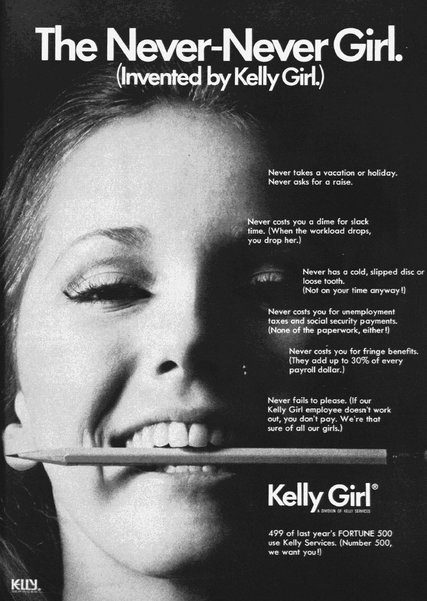
Kelly girl

Politicians across the political spectrum herald “job creation,” but frightfully few of them talk about what kinds of jobs are being created. Yet this clearly matters: According to the Census Bureau, one-third of adults who live in poverty are working but do not earn enough to support themselves and their families.

A quarter of jobs in America pay below the federal poverty line for a family of four ($23,050). Not only are many jobs low-wage, they are also temporary and insecure. Over the last three years, the temp industry added more jobs in the United States than any other, according to the American Staffing Association, the trade group representing temp recruitment agencies, outsourcing specialists and the like.

Low-wage, temporary jobs have become so widespread that they threaten to become the norm. But for some reason this isn’t causing a scandal. At least in the business press, we are more likely to hear plaudits for “lean and mean” companies than angst about the changing nature of work for ordinary Americans.

Read More

Flu Outbreak: Why Paid Sick Days Matter

By Shamus Khan

(This article was originally published on Time.com. The original version can be read here: Read here: http://ideas.time.com/2013/01/22/flu-outbreak-why-paid-sick-days-matter/#ixzz2JBd5yMZo)

We are in the midst of one of the worst flu seasons in recent memory. By the end of it, about 60 million Americans are likely to contact influenza, over 200,000 will probably to be hospitalized and tens of thousands will have died. While we typically look to doctors and medicines in a health crisis, we should recognize that guaranteeing paid sick days to workers could do as much, if not more, to help moderate the impact of influenza and other contagious diseases.

Every other industrialized nation in the world guarantees this right, but very few places in the U.S. do; they include a handful of cities like San Francisco, Milwaukee, Washington and Seattle — and one lone state: Connecticut. What that means is if you live anywhere else in the nation, you can be fired for missing work because of an illness or for caring for a sick family member.

Read More

Eduardo Porter had a nice piece in the New York Times two days ago entitled “Unionizing the Bottom of the Pay Scale.” His article dovetails with my recent post here on how mainstream economics has little to say about the the problem of growing structural demand for low-skill service workers.

In Porter’s words:

“To improve the lives of American workers, most economists argue, we might do better by focusing on education to equip them with the skills to perform more productive, better-paid jobs.

But this argument overlooks the fact that the McJob is hardly a niche of the labor market reserved for the uneducated few. Rather, it might be the biggest job of our future.”

He goes on to note that “In countries where more than half of workers belong to a union, only 12 percent of jobs pay” low-wages.

For readers who have not been following this union drive, Steven Greenhouse also had a story on it last week, in which he quoted eminent labor sociologist Ruth Milkman on the problem of organizing such a transient workforce.

In last weekend’s New York Times Magazine, Adam Davidson had a nice article debunking the so-called skills gap in manufacturing. He noted that manufacturers constantly complain about not being able to hire skilled workers – yet they offer starting pay as low as $10 per hour.

One manufacturer Davidson spoke with stated that workers with an associate degree can make $15 per hour in his factory. Yet, as Davidson noted “a new shift manager at a nearby McDonald’s can earn around $14 an hour.” The problem is not lack of skilled workers, but that manufacturers are offering wages too low to attract skilled workers.

Some employers are willing to train but even they are facing a deficit in basic math and science skills, which are increasingly important for modern, computer-based manufacturing. Davidson closes by suggesting that “so-called skills gap is really a gap in education, and that affects all of us.”

While it may be true there is a general education deficit in the US, this barely scratches this surface of a deeper problem facing postindustrial economies: what kinds of jobs are replacing formerly-well paying manufacturing jobs as these are outsourced to low-wage countries and lost to advancing technologies?

Read More