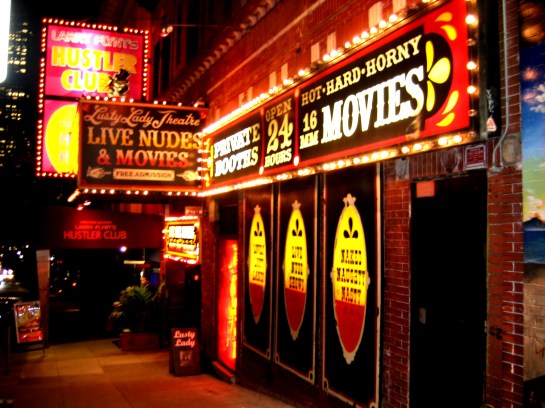
The Lusty Lady peep show in San Francisco (Wikimedia Commons)
by Gregor Gall
The Lusty Lady peepshow, based in San Francisco, was the pinnacle of the achievements of the global sex worker unionisation phenomenon. Between 1997 and 2013, union recognition, collective bargaining and job control existed under conventional management and then under cooperative ownership (when the establishment closed due to financial pressures). Its peculiarity in comparison to the vast majority of other sex workers highlights the broad and substantial nature challenges for sex worker unionisation.
The exotic dancers at the Lusty Lady were employed, paid a minimum wage and not in direct contact with customers. The imports of these were they could use the certification law to gain union recognition (which self-employed workers cannot), they were not in competition with each other as other dancers usually are for customers and the Service Emlployees International Union was amenable to helping organise them given it did not have to practice ‘open source’ unionism to do so.
Furthermore, the Lusty Lady attracted a certain kind of dancer, namely, politically progressive women, and the establishment was a peepshow and not a lapdancing or strip club where clients have more influence over dancer performances.









 by Jeffrey S. Rothstein
 Work in Progress