Archive

Commentary

by Erin A. Cech and Mary Blair-Loy

The widespread fascination with the TV series Mad Men is partly due to the stark contrast it draws between the postwar professional workforce portrayed in the series and the realities of that same workforce today. Although still largely male-dominated, professional occupations are no longer predominantly populated by men who serve as family breadwinners and have stay-at-home spouses. Women are in the workforce standing shoulder to shoulder with men as household earners and nearly half of couples with young children now juggle childcare responsibilities along with two careers. Despite a professional workforce demographic that is decidedly post-Mad Men, workplace arrangements and expectations of “ideal workers” in professions today could be ripped right out of a Mad Men script.

Read More

img24423138

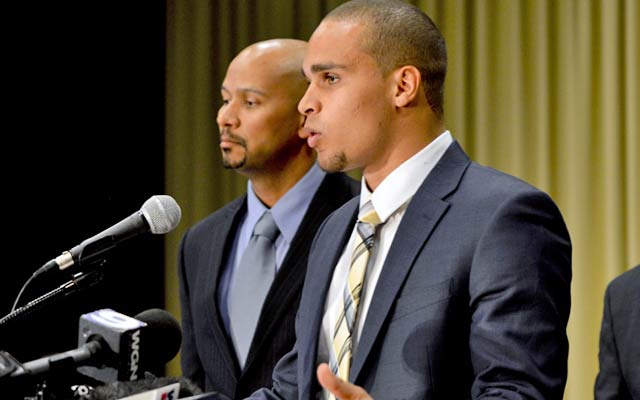
Kain Coulter (R), Northwestern University’s football quarterback, and Ramogi Huma (L), head of the College Athletes Players Association ; Source: CBS Sports

The regional arm of the National Labor Relations Board (NLRB) ruled last week that Northwestern University’s scholarship football players have the right to unionize. This is only the first step for the players, who will likely face an appeal from the University to the NLRB’s full board in Washington, D.C. If the initial ruling passes muster with the NLRB, it can also be appealed to the U.S. Supreme Court, so there is a long road ahead for this case that has exposed quite publicly the tensions within big-ticket college athletics. The crux of the case is this – do scholarship athletes qualify as employees of the University?

Read More

by Noelle Chesley

Mobile-on-a-Boat-Ride

Credit: LexnGer (Creative Commons BY-NC 2.0)

As technology has become an inescapable part of most workplaces, it has become ever more important to understand its impact on employees. Using data from two surveys of U.S. workers, Noelle Chesley examines the effects of both personal and job-related technology use. She finds that increased technology use, especially when it extends work into personal life, is linked with higher levels of worker distress. However, it is also associated with gains in productivity, and personal technology use at work may help employees to manage work-related stress.


Read More

A news story has been making the rounds in academic circles about a newly minted PhD job candidate who, when offered a tenure track faculty position at Nazareth College, attempted to negotiate salary and conditions only to have the college rescind the offer entirely. Here is the email the candidate says she sent the search committee:

Read More

On both sides of the Atlantic the economic recovery is seems to be gaining pace. Quantitative easing is being eased in the US. In austerity Britain, ‘the plan is working’ according to Prime Minister David Cameron. He seems to have some evidence for this claim. According to the latest labour market data from the UK’s Office for National Statistics, a record number of people are now in work –  that’s more people now in jobs than ever before in the UK.

The headline figures show that unemployment is down (0.3%) and employment up (0.4%) in the UK.  However digging below the headlines reveals a more mixed picture, with differences by region. Unemployment is highest in the North East and lowest in the East of England. Scotland though has lower unemployment than the UK overall and Northern Ireland a higher rate. The employment rate is highest for the South East of England, which includes the economic hothouse of London, and lowest in the North East. Economic inactivity is highest amongst people in the North West of England.

Read More

The beauty of contrast is that looking at one thing makes you focus on another. That is true in art but also for work and non-work. Which is why looking at pictures of motherhood can make us appreciate how important our images of work are: work does not work until we know what work looks like.

In late 2013, two contrasting photo series of women as mothers made the news in the UK. The first series was of Licia Ronzuli, Italian member of the European Parliament, and her daughter Vittoria. Pictures taken in parliament showed mother and daughter over three years, Victoria on her mother’s lap, playing with whatever tools of the trade were within the reach of her growing arms (pens, paper, headphones) and learning to raise her arm(s) to vote. In an earlier interview, Ronzuli said she brought her daughter to the workplace as a political act, to make women’s struggle between careering and caring more visible. The second series was the polar opposite: a collection of baby photographs from Britain’s Victorian days. Back then photography required several minutes of exposure, so mothers camouflaged themselves as chairs and curtains to hold their little darlings still for long enough. The babies’ expressions range from sceptical to petrified while their mothers morph into shapeless background figures.

Read More

In a recent op-ed in the New York Times, Nicholas Kristof lamented the lack of influence of professors in “today’s great debates.” Many academics took to the blogosphere retorting that, yes, in fact, public intellectualism is alive and thriving in the academy. My colleague Chris Prener posted a more sympathetic response on this blog, arguing that having a twitter account and a blog does not make an academic a public intellectual. It is the content of the message, not the medium, which matters.

Both Chris and I agree with Kristof that there are not enough public intellectuals because of structural and cultural barriers within the academy, including a tenure process that rewards only academic output and places severe time constraints on the ability of academics to engage wider audiences.

Unfortunately, Kristof completely loses the plot when he suggests that economics is more engaged in “real-world debates” than sociology because the former has more Republican members (plus more “empiricism and rigor”).

Read More

by Julie A. Kmec, Lindsey T. O’Connor, and Scott Schieman

President Obama’s State of the Union address last month recognized that working women—and men—should not face hardship for taking care of their family responsibilities.Recent research by sociologists,Julie A. Kmec, Lindsey Trimble O’Connor and Scott Schieman suggests that workplaces have a long way to go before realizing the President’s message.  In new research, they find that working mothers perceive penalties—like feeling ignored and that they are given the worst tasks—when they adjust their work schedules after having children.  They suggest that policies and practices that challenge societal assumptions about ideal work are a good starting place in attempts to realize President Obama’s call to give working parents a “break.”

Read More

Over the weekend, Nicholas Kristof wrote a widely read piece asking where the public intellectual has gone. For those of you who may have missed the editorial, Kristof argues that the culture of PhD programs and the tenure process have forced the academy inward, celebrating dense prose published in little-read, high-priced journals. He notes that academics have been slow to embrace blogging and the use of social media platforms. Kristof also argues the research academics produce has far fewer consequences or conclusions for policy and the public than it has in the past, meaning that the “public intellectual” is a dying breed.

Almost immediately, the various public intellectuals that Kristof couldn’t find took to their blogs and Twitter accounts with gusto, reminding him and us that there are indeed many academics that have made a point of sharing their work on public platforms. Perhaps my favorite response comes from a guest post at Tenured Radical. The writer argues that, as a public university professor, she works as a “public intellectual” every day of the week. Kristof has re-tweeted many of the critiques, creating a running dialogue about his piece on his Twitter feed.

Read More

While the first flight attendants were male and many early airlines had a ban on hiring women, flight attending would eventually become a quintessentially female occupation.  Airline marketers exploited the presence of these female flight attendants.  Based on my reading — especially Phil Tiemeyer‘s Plane Queer and Kathleen Barry’s history of flight attendants’ labor activism — there seem to have been three stages.

Read More