Archive

News Analysis

A news story has been making the rounds in academic circles about a newly minted PhD job candidate who, when offered a tenure track faculty position at Nazareth College, attempted to negotiate salary and conditions only to have the college rescind the offer entirely. Here is the email the candidate says she sent the search committee:

Read More

TV chef Paula Deen is the most recent celebrity to become caught in a scandal related to racist language or behavior. In breaking the story, most news outlets have emphasized Deen’s deposed statements admitting that she has used racial epithets for blacks, describing her admiration for a restaurant that evoked Civil War era-racial imagery of black men in service professions, and her fear that her wish to plan a wedding around that theme would be “misinterpreted.”


However, many reports overlook an important aspect of this story—the way in which it reveals the persistence of ongoing racial discrimination at work.

Read More

A recent article on Forbes purported to rank the least stressful jobs, and perhaps predictably, sparked outrage among academics when it ranked being a university professor as the number one least stressful job. The article contains some dubious claims that might make you do a double-take if you work as a professor–among them that professors are “off” from May-September, enjoy long breaks during the school year, that there is “some” pressure to publish (!) and that “deadlines are few”. The ranking is based on markers of stress including but not limited to travel, competitiveness, growth potential, and risk to one’s own life or others.

Read More

The New York Times recently published an in-depth article on “Apple’s Retail Army, Long on Loyalty but Short on Pay,” as part of its excellent series on “The iEconomy.” The new article notes that the majority of Apple’s US workforce (30,000 of its 43,000 domestic employees) are not engineers – part of the hailed “creative class” typically associated with the likes of Apple – but hourly retail sales employees.

Last year, the article reports, “each Apple store employee — that includes non-sales staff like technicians and people stocking shelves — brought in $473,000.” Yet, many of these employees are paid just $25,000 per year.

The most common definition of low-wage work used in international comparative research is two thirds of the median income. In the US, the median income in 2011 was $34,460. This puts the typical Apple store employee at 73% of the median, making employment in an Apple store effectively a low-wage job.

Read More

The continuing presidential campaign in the United States has been dominated by a number of noticeable trends, including contentious debates about reproductive rights specifically (what some have called the “war on women“) and, more broadly, about gender roles in American society (think about the recent commentary on Ann Romney, a topic Adia has blogged about). There has also been much discussion about the state of the economy in the United States and continuing issues of un- and under-employment (see my posts here and here).

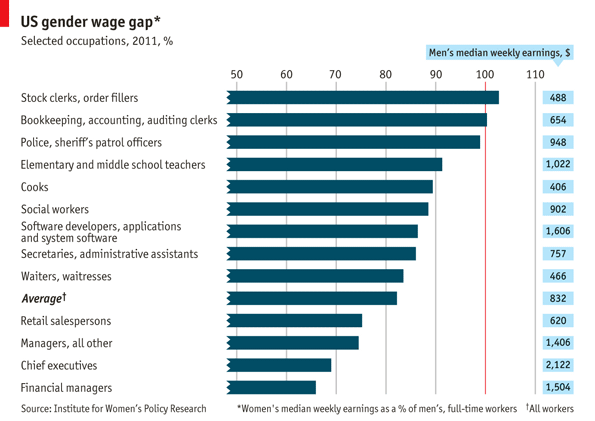
An important intersection of these two political debates is the counting disparity in pay by gender. A recent article in The Economist, citing work done by the Institute for Women’s Policy Research, documented this phenomena, noting that women continue to earn, on average, 82.2% of what men earn. This gap, as the graphic below shows, varies considerably by occupational category.

Image via The Economist (April 17, 2012)

In the following three pieces, our regular bloggers Adia Harvey Wingfield and Julie Kmec join guest blogger Rebecca Glauber in dissecting some of the causes and debates surrounding the gender wage gap, both within and outside of sociology.

I’ve been using a lot of air quotes in my classroom discussions, and I’m finding it a bit troubling. Not just because the quotes date me to the late 1990s, but also because they are inadequate stand-ins for something that needs to be said. Those gestures you make by your ears that slip out with little warning, shooting up from your hip mid-sentence as if to add irony, complexity, and intrigue. Women’s and men’s “choices” in work. Women’s and men’s “choices” in family.

Read More

A recent WSJ article by Kay Hymowitz (Why Women Make less than Men, April 26, 2012 ) reports that “most people have heard that full-time working American women earn only 77 cents for every dollar earned by men. Yet these numbers don’t take into account the actual number of hours worked. And it turns out that women work fewer hours than men.” Hymowitz continues, citing Labor Department statistics indicating more than half (almost 55%) of workers who work more than 35 hours per week (what the department defines as full time work) are men and suggests that the sex wage gap is “to a considerable degree a gender-hours gap.”

Read More

Julie and Rebecca have cited important sociological analysis that documents the fact that net of hours worked, the gender wage gap remains such that men still outearn their female peers in the same occupations. One other piece of commonsense wisdom often cited to explain the wage gap is the argument that women select occupations that tend to be lower paying—teaching, nursing, and other positions that we tend to associate with women. According to this line of reasoning, women are more likely to self-select into the “feminized” positions within certain fields, which then contributes to gender inequality in the labor market.

Read More

Apple Inc. is the largest technology company in the world, in terms of both revenue and profit. Yet, the California-based company has just 47,000 workers on its payroll in the United States. Apple recently released a report in which it claimed responsibility for “indirectly” creating an additional 257,000 American jobs in industries that are part of its supply chain, a claim that was “disreputable,” in the words of MIT labor economist David Autor – as if Apple’s suppliers did not have any other customers. Or, as Wharton labor economist Peter Cappelli noted, as if the consumers spending their money on an iPad would not have purchased another product in its absence (see a New York Times article on debates over the report here, including comments from Autor and Cappelli).

While Apple’s claim to have created jobs for UPS and FedEx employees is questionable, however, there is some truth to the argument that Apple is responsible for the employment – and working conditions – at its key suppliers, particularly manufacturers for which Apple is the main customer. This may be the case for some Corning employees in the US (supplying glass for iPhones) and is very likely the case for, tens, perhaps hundreds of thousands of employees at Foxconn in China, which presumably has entire lines or buildings dedicated to Apple.

A recent report by political economist and accountant Karel Williams and his research team at the Centre for Research on Socio-Cultural Change at the University of Manchester looked at the Apple Business Model and its employment effects. They cite a study which found that Chinese workers add $6.50 in value to each iPhone 3, just 3.6% of the phone’s shipping price.

Read More