Archive

Research Findings

5816111188_9a0be816be_b

Image: Jason Hargrove via Flickr (CC-BY-NC-2.0)

by Nancy Galambos and Harvey Krahn

When we read about youth, titles like Generation X, Generation Me and Arrested Adulthood tend to paint an alarming picture of the younger generation in their 20s as directionless, floundering, and less likely than previous generations to become mature and productive citizens. In contrast, books like The Boomerang Age and Emerging Adulthood argue that more recent socio-demographic trends indicative of instability in education, employment, and living arrangements, as young people move from one job to another, seesaw between education and work, switch from one educational program to the next, and sometimes come back home to live with their parents are relatively benign.

There is no doubt that post-baby boom birth cohorts (labelled as Generation X, Generation Y, the millennials, and so on) have experienced such fluctuations, but are these experiences interpretable as floundering or do they merely reflect the freedom of young people in western societies today to explore their options until they find the best fit? Answers are important because we need to know whether shifts in how young people navigate the transition to adulthood are cause for concern and require appropriate policy interventions or whether they are simply reflective of a new and adaptive way of entering adulthood. In new research, we argued that fluctuations in employment and education statuses cannot be interpreted negatively as floundering, or more positively as exploring, unless we know something about their longer-term employment and career outcomes.

Read More

Books

Image: Johannes Jansson via Wikimedia Commons (CC BY 2.5)

by Jake Rosenfeld

The delivery service start-up Jet.com promises many things to its employees, including unlimited vacation, generous parental leave, and meals provided by the company. Many Silicon Valley firms now provide similar perks as they seek to entice workers in a tightening labor market.

What sets Jet.com apart from its peers is the promise of something ostensibly less tangible: financial transparency. The firm offers its salaried employees real-time financial information detailing how the company is performing. Why share such valuable data? The practice is part of the firm’s effort to cultivate a culture of transparency, which, CEO Marc Lore hopes, will engender greater worker trust, happiness, and, in the end, productivity.

Workers and their representatives have fought to “open the books” of their firms for generations. In the United Auto Worker’s strike against General Motors in 1945-1946, union leader Walter Reuther demanded access to the company’s financial information. GM resisted, as did many firms then and as many continue to today, classifying company financial data – information like detailed revenue reports – as proprietary, and off-limits to employees.

The existence of the exceptional companies like Jet.com, who preach and practice transparency, allows us to examine what, if any, tangible consequences financial transparency has on productivity, company profits and worker pay.

While it is too soon to tell whether Lore’s gamble on transparency generates a happier, more productive workforce, my research with fellow sociologist Patrick Denice suggests it could lead to a higher-paid workforce – an outcome Lore may not have intended.

Read More

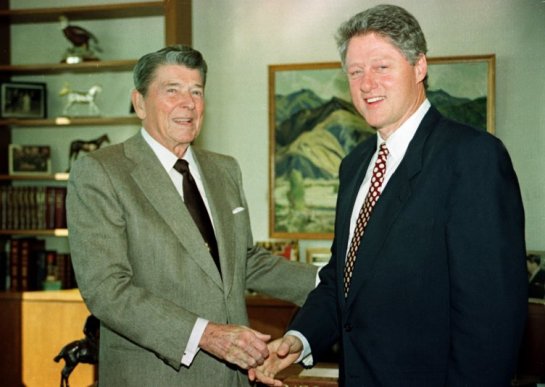
1009-bill-clinton-ronald-reagan

Image: Reuters via Newsweek.

by David Jacobs

“It is our job to glory in inequality and to see that talents and abilities are given vent and ex­pres­sion for the benefit of us all.” –  Margaret Thatcher

“A quick glance at the curves describing wealth inequality or the capital/income ratio is enough to show that politics is ubiquitous and that economics and political changes are inextricably in­ter­twined and must be studied together.” – Thomas Piketty, Capital in the Twenty-First Century, p. 577

What factors best explain the remarkable expansion in U.S. income inequality?  In a striking re­ver­sal in the long trend toward greater economic equality in the affluent democracies since 1900, the dif­fer­enc­es in U.S. family incomes accelerated sharply after 1980 (see Fig­ure 1) after experiencing only modest growth.  This de­par­ture, although present in other wealthy demo­cracies, has been less pro­noun­ced else­where.  Yet as the quotes above suggest, it is difficult to be­lieve that po­litics did not have a major influence on the rapid increase in income inequality after 1980.  To date, however, little syste­matic evidence for such a claim has been avail­able.  Yet political ac­counts are likely to mat­ter more in some per­iods as gov­ern­mental con­trol shifts from one political party to another.

Figure 1 –   Fluctuations in U.S. Income Inequality, 1951 – 2011

David-Jacobs-Fig-1

Note: Larger values denote greater inequality; vertical lines denote partisan shifts in the Presidency and “Rep” stands for Republican while “Dem” stands for Democratic Presidents.

With these as­sumptions in mind, Lindsey My­ers and I con­ducted a longitudinal analysis of the factors that pro­duced yearly changes in family in­come inequality from 1951 to 2010. We find that the steep decline in union strength and deregulation of the financial industry that occurred after Ronald Reagan’s presidency began in 1981 has contributed to the stagnation of middle incomes and the rise of income inequality.

Read More

450px-ProtectedByPinkertonsSignNOLA

Precarious work is now at the forefront of much academic research and journalism, and with good reason. These investigations show that precarious employment has led to increased instability, insecurity, and vulnerability for a significant and growing population of workers.

Yet I believe there is more work to do in this vein. We need to identify how this sprawling sector of the economy is changing the rules of employment for workers. Because all workers—and disadvantaged workers in particular—who are already “playing” this “game” on an unequal playing field are losing rights and power at work.

An example of this much-needed research is the recent report by Reveal News’ Will Evans, which documents racism, sexism, and other discriminatory hiring practices in temp agencies. As this report shows, at least some employers are outsourcing illegal discrimination to the temporary help industry. Yet such practices are obscured—and, therefore, largely undetected—because of the convoluted structure of temp work and lagging employment law. In particular, the originator of the discrimination is obscured because the employers who insist, for example, that temp agencies send only “country boys” (i.e., white men) or “mujeres” (i.e., Hispanic women) are not the legal employer of record and are therefore not held responsible for illegal hiring practices. Meanwhile, the enactor of the discrimination—those temp agency managers so eager to keep companies’ business that they readily engage in illegal practices—can easily hide behind the presumed precarity of the temp economy, dishonestly telling only some temps that no jobs are available or that their jobs have been suddenly canceled.

This is not an inevitable outcome of the temp economy, but when such illegal actions are unregulated and overlooked, it is not surprising that they have become one of the ways that employers use temp agencies to change the rules of the labor market for workers.

Read More

Felix_von_Luschan_Skin_Color_chart.svg

von Luschan skin color chart (Wikimedia Commons)

by Andrea Gómez Cervantes and ChangHwan Kim

Racial divisions between black and white have marked American society throughout history. Color lines have been synonym to racial division and social inequality. Recently, the demographic composition of the country has changed, becoming more diverse due to growing new immigrants and multiracial populations. It is predicted that by 2065, one in three Americans will be an immigrant, or have immigrant parent, with Asians expected to be the largest immigrant group (38 percent among immigrants), followed by Hispanics (31 percent), whites (20 percent), and blacks (9 percent). In contrast the white, native-born population is expected to decrease from 62 to 46 percent. Social scientists attempt to understand the changing demographic composition of the country and its implications for social stratification. While some point to the continuing divide between blacks and whites, others argue that new immigrants reshape racial divides, either by blurring the color lines, or by re-establishing them.

In new research, we explore the way immigrants fit into these existing racial divides by looking at the intersection of gender, skin color and race in immigrants’ employment possibilities. We find that for male immigrants, darker skin color has a substantial negative effect on employment, while for women skin color had no effect on employment.

Read More

Unicef

Image: UNICEF Ukraine via Wikimedia Commons

by Christiane Bode, Jasjit Singh and Michelle Rogan

The essence of capitalism is that companies create value for society by focusing on their own profits. However, this narrative has increasingly come under pressure taking the form of protests and boycotts. In response to societal backlash and due to the emerging belief of managers that firms do have societal responsibilities beyond those that naturally emerge from their profit motives, companies are in turn launching initiatives with explicitly stated social impact objectives.

Indeed, current popular wisdom suggests that such explicit corporate social engagement could ultimately benefit not only society but also firms. If corporate employees want to “have their cake and eat it too” – in other words, to have a corporate career and be directly involved in making a visible contribution to society – then social engagement could benefit firms while benefiting society.

To test this argument, in an article recently published in Organization Science, we examine whether participation by corporate employees in an initiative with an explicit social impact objective is positively correlated employee retention, a key performance outcome for many firms.

Read More

4132414326_ce10c42583_b

Image: Steve Rhodes via Flickr (CC-BY-NC-SA-2.0)

by Jiwook Jung

In February, 1993, IBM, the world’s largest computer maker, announced that it would order the first layoffs in its then 80-year history. In the face of tougher international and domestic competition, the company had suffered from a steady decline in profitability and slow growth throughout the 1980s; workforce adjustment and cost reduction seemed warranted. Nevertheless, IBM’s decision marked a drastic departure from its acclaimed tradition of lifetime employment. Throughout its history, it had prided itself on caring for its employees. Seen in a broader context, however, what was truly remarkable was the fact that the company had managed to avoid layoffs for so long; most of its peers had already accepted the practice as necessary.

Indeed, corporate America had experienced waves of downsizing since the 1980s. And even before the 1980s, firms made layoffs during economic downturns. But the 1980s marked a sea change in the layoff policy of large US companies. Whereas layoff had previously meant temporary suspension of employment with an explicit or implicit agreement that laid-off workers would be called back when economic situations improved, it has recently come to mean permanent termination (see Figure 1 below). Moreover, unlike in the past, even healthy, profitable companies have begun to engage in downsizing. For instance, in 1993 Xerox announced its plan to cut 10,000 jobs or nearly 10 percent of its work force, although the company had been consistently profitable before the announcement. Its CEO explained that in order to compete effectively, the company would have to be lean and flexible.

Read More

Image: UNIDO via Flickr (CC BY-ND 2.0)

Image: UNIDO via Flickr (CC BY-ND 2.0)

by Maria Azocar and Myra Marx Ferree

Important changes are under way in the world of lawyers. Their work has become increasingly dominated by large organizations, globalization has re-structured their work to be increasingly transnational, and demographic changes have redefined the profession. For example, an increasing participation of women in the legal profession is a global trend, with Latin American countries leading the rankings in terms of the number of women who enroll in and graduate from law schools.

What can the sociology of professions say about these changes? The consensus view of the field would be that these changes will translate into increasing jurisdictional battles over lawyers’ claims to expertise. Expertise is sociologically understood as knowledge that people have to accomplish a given task (Abbott 1988; Freidson 2001; Larson 1979). In this scholarship, the focus of study is often on the sites where expertise is produced and recognized, for example in practices of credentialing and licensing. Gender (and other) inequalities in a profession would be analyzed in terms of women’s struggles with men who are often considered more valuable workers or through considering the causes and effects of sex segregation in setting values, rewards or access to power.

These are important insights, but from a gender perspective, expertise not only involves practices of discrimination against women or the segregation of women from men. Expertise can itself be gendered through the differential evaluations of competences and expert claims. Science studies, especially actor-network theory (Latour 1987, Eyal 2013), also suggest asking how objects, technologies, and institutions are gendered and how they acquire stability as jurisdictional boundaries. In addition to claims and competences, networks of social arrangements can be gendered, and their gender can work independently of the gender of the individuals making use of them to advance their relative position.

Read More

Image: mSeattle via Flickr (CC-BY-2.0)

Image: mSeattle via Flickr (CC-BY-2.0)

by Matthew Wright

Recent studies highlight a growing class gap, in terms of prosperity and opportunity, between present-day Americans and the cohort that came of age in the 1950s. The root causes of this trend, however, have yet to be fully understood. In new research, I present systematic evidence confirming a growing class polarization in ‘social capital’ among American youth tracing back to the mid-1970s, and tie this trend explicitly to growth in economic inequality over that period.

Read More

Image: photologue_np via Flickr (CC-BY-2.0)

Image: photologue_np via Flickr (CC-BY-2.0)

by Louis-Philippe Beland

Politicians and political parties play a crucial role in the US economy. The common perception is that Democrats favor pro-labor policies and are more averse to income inequality than Republicans. In recent research, I evaluate the impact of political party affiliation of governors (Republican versus Democratic) by looking at the following labor market outcomes: hours worked, weeks worked, employment, labor-force participation, and earnings. Given that there is an important and well-documented earnings gap between black and white workers, I investigate whether the party affiliation of governors affects this gap.  This is an important issue given that a large proportion of black workers vote for Democrats.

I find that under Democratic governors, blacks are more likely to work, participate in the labor market, and work more intensively. This leads to an increase in the annual hours worked by blacks relative to whites, which decreases the earnings gap between blacks and whites.

Read More