Archive

Research Findings

stokes_image1by Allyson Stokes

Fashion design is an occupation where women far outnumber men, yet there is a widespread perception that gay men are the most successful. Scholars, journalists, and industry insiders have all commented on how gay men (e.g. Tom Ford, Marc Jacobs) are “media darlings,” win more awards, and have more prestigious jobs. Why is this the case?

On the one hand, gay men’s successes in fashion design are cause for celebration. LGBTQ people have historically faced discrimination and disadvantages in the broader labor market, but fashion is one of a few creative fields considered more or less “gay friendly,” and it employs large numbers of gay men. However, recent research finds that even “gay friendly” workplaces can reproduce old stereotypes and inequalities between gay and straight, men and women. And since fashion design is numerically dominated by women, the success of men designers is suggestive of gender inequality.

Read More

Image: pixabay.com

Image: pixabay.com

by Michael L. Rosino, Devon R. Goss, and Matthew W. Hughey

One only need picture the typical American corporate boss (white, male, and wealthy) in order to conjure up the history of discrimination and inequality within the business realm. Over the past few decades, business leaders have attempted to address these problems through efforts oriented at increasing diversity. For instance, in 2014, major tech companies including Google, Apple, Twitter, and Facebook released their diversity statistics in reports to the media under pressure from journalists and activists. While the reports revealed the overwhelming white masculinity of the modern corporation, the companies still framed their statistics as reflecting their commitment to diversity.

The release of these reports garnered media speculation about the causes of this lack of racial and gender diversity and the implications for the future of race and gender inequalities. Alongside news publications such as the New York Times and Washington Post, articles in business media outlets such as Forbes, Businessweek, and The Wall Street Journal also weighed in on “Silicon Valley’s Diversity Problem” as these elements of the 4th estate have long discussed diversity initiatives in the business world.

Despite the active discussion on the wide spectrum of abstract issues around diversity, business media outlets generally present business diversity in highly specific terms. Activists and scholars might argue that diversity—especially along the lines of race, gender, and sexuality in the business sphere—matters due to concerns about macroeconomic stability, ethical fairness, and/or social justice. However, articles published in business media outlets often discuss the merits of business diversity efforts solely in terms of the “business case” for diversity.

Read More

Waitress_taking_an_order

Image: Wikimedia Commons.

by Patti Giuffre

The customer is always right. I found out about this idea soon after I started working as a hostess, and then moved up to be a cocktail waitress, bartender, and food server. I did this work because the managers offered me the job on the spot, and, I took home quite a bit of tip money as a teenager and during my twenties. During most of the shifts that I worked, men customers engaged in sexist or sexual comments or innuendos. Not once in over 8 years in three different restaurants and bars did I say, “You’re making me uncomfortable.” I wanted a big tip! I also didn’t know what to say, and I certainly didn’t want to tell my managers because I thought it would make them uncomfortable and make me (the employee) look bad. I once mentioned a customer who was touching me too much and my manager said, while rolling his eyes, “What do you want me to do about it?” We received the message that the customer is always right in many ways when management sided with customers, no matter how obnoxious their behaviors.

Read More

Photo via http://www.whitehouse.gov/blog/2015/01/26/highlights-president-obamas-visit-india

Photo via The White House

Excitement about India’s role as a rising power was again highlighted by Barack Obama’s state visit to New Delhi in January. Indian Prime Minister Narenda Modi has also made a series of high-profile international visits since his election victory last year. But, as I originally blogged at Progress in Political Economy in February, the reality of work and life in the new India is radically different to the sparkle of Modi’s globe-trotting.

This contrast has been highlighted by many writers (including my colleague, Dr Elizabeth Hill – see her review of Rina Agarwala’s important new book on informal labor in India) and is something I take up in my new book, Informal Labour in Urban India: Three Cities, Three Journeys. The last quarter century of rapid economic growth in India has been underpinned by the mass employment of ‘informal labor’. The book uses case studies of economic development in three urban regions of India: Mumbai, Bengaluru (Bangalore) and the National Capital Region (NCR) of Delhi. I wrote this book after undertaking seven years’ research on India’s informal economy, including my doctoral research with the Department of Political Economy at the University of Sydney. When I first considered undertaking a PhD, I was interested in the impacts of trade and investment between India and Australia on labor markets. I quickly discovered what, for me, was a far more interesting story about India’s transition from a relatively inward-looking, low-growth economy to a globally-integrated, high-growth economy and the impact on employment and livelihoods.

Read More

Walmart-Logo_color_0Walmart made headlines recently by announcing it is raising its base wage rate to $9 per hour (going to $10 per hour in 2016). In response, Gary Silverman of The Financial Times suggests that “Walmart stirs hopes of a Fordist revival,” referring to Henry Ford’s famous implementation of a $5 day in 1914 – double the going rate at the time. Similarly, Paul Krugman, Princeton economist and New York Times columnist, argues that Walmart’s “wage hike seems to reflect the same forces that led to” rising real wages and declining inequality for nearly three decades after the Second World War.

While the comparison between Walmart and Ford is apt in some respects, unfortunately, the broader institutional context of today’s postindustrial, globalized, financialized economy is far different from that of the post-WWII years. As a result, the move by Wal-Mart is unlikely to signal a broad reversal of the current trajectory of the American labor market, which is characterized by stagnating wages and rising inequality.

Read More

5058063788_3313b8a46f_z

Image: Francisco Martins CC BY-NC 2.0

The news in 2014 was regularly punctuated with stories of care home residents suffering abuse. As a result, care workers have been prosecuted and sentenced and homes have been closed, yet hidden camera exposes produced by residents’ relatives and by documentary film makers continue to highlight further incidents. The picture is grim. So it’s perhaps unsurprising that we have heard resurgent calls, from politicians, professional bodies and journalists, for a return to ‘compassionate care’. These calls usually emphasise the need for care workers to be re-trained so that they can learn (or re-learn) empathy. Sometimes this is juxtaposed to an emphasis on professional qualifications. For instance, UK Prime Minister, David Cameron suggested that ‘nurses should be hired and promoted on the basis of having compassion as a vocation not just academic qualifications’.

Yet, this widespread interpretation of recent crises in the care sector misunderstands the logic of care work. Simply put, it ignores the fact that care work is a type of what scholars have termed ‘body work‘: paid work that requires workers to touch, manipulate or otherwise work on, and in direct contact with, the bodies of others. For various reasons, summarized below, body work is extremely difficult to standardize or make profitable. Yet a privatized care regime is premised on companies’ ability to do precisely this: realize profit through standardization and capital-labor savings. In this context, one in which private care companies attempt to achieve largely unachievable goals, there is no reason to believe we have seen the last harm to residents nor a shift away from care practices that systematically undermine the dignity of those being cared for. Meanwhile, care workers employed by private companies have become residual casualties; unable to compensate for the structural problems endemic to privatized body work and demonized by the media when things go wrong. Read More

Source: buffy.wikia.com

Source: buffy.wikia.com

Now that 55 million U.S. children are back in school, parents, teachers and school administration have been gearing up for the rest of school year ahead. However, one group of individuals who are often overlooked in our cultural imaginations of schools are the lunch ladies (also referred to as school food service employees). More importantly, this group of workers are poorly misunderstood and are often not considered at all. Not only are lunch ladies invisible in academic research, but they are invisible in our national conversation about the quality of school food.

It is important to draw our attention to the work of food service employees so that we may have a better understanding of how they impact children’s health. Although overlooked in considerations of children’s health, lunch ladies do have an impact on children’s lives each day.

When we do see portrayals of lunch ladies in popular culture, they are often portrayed as one-dimensional. This undermines our ability to consider lunch ladies as partners in improving children’s school meals. Based on a media content analysis, I have found that lunch ladies are more often than not portrayed as villains. Read More

14369445149_02fd85515b_k

Annette Bernhardt, Flickr

By Nicki Lisa Cole and Jenny Chan, for Truthout

Apple made headlines in late January 2015 when it reported the largest quarterly profit ever in corporate history: $18 billion. A record-breaking $74.6 billion quarterly revenue generated this profit, thanks in large part to the sale of 74.5 million iPhones during the same period.

For Apple, this is a great start to 2015, just as 2014 was a fantastic year for the company. Last year, they sold more than 169 million iPhones, (1) which earned them nearly $102 billion in sales. With $183 billion in total 2014 revenue, and $39.5 billion in profit, (2) Apple is the most valuable company in the world.

But for many hundreds of thousands of young Chinese toiling on Apple assembly lines, 2014 was not such a good year. Reports from China Labor Watch (CLW) and Students and Scholars Against Corporate Misbehavior (SACOM), and evidence gathered by researchers Jenny Chan, Mark Selden and Pun Ngai detail a litany of labor law violations at numerous factories across China. Troublingly, this evidence shows that many of the same problems reported to Apple in 2013 continued unabated through 2014. Conditions have in fact worsened at several sites.

Read More

Teen barista

Source: Wikimedia Commons

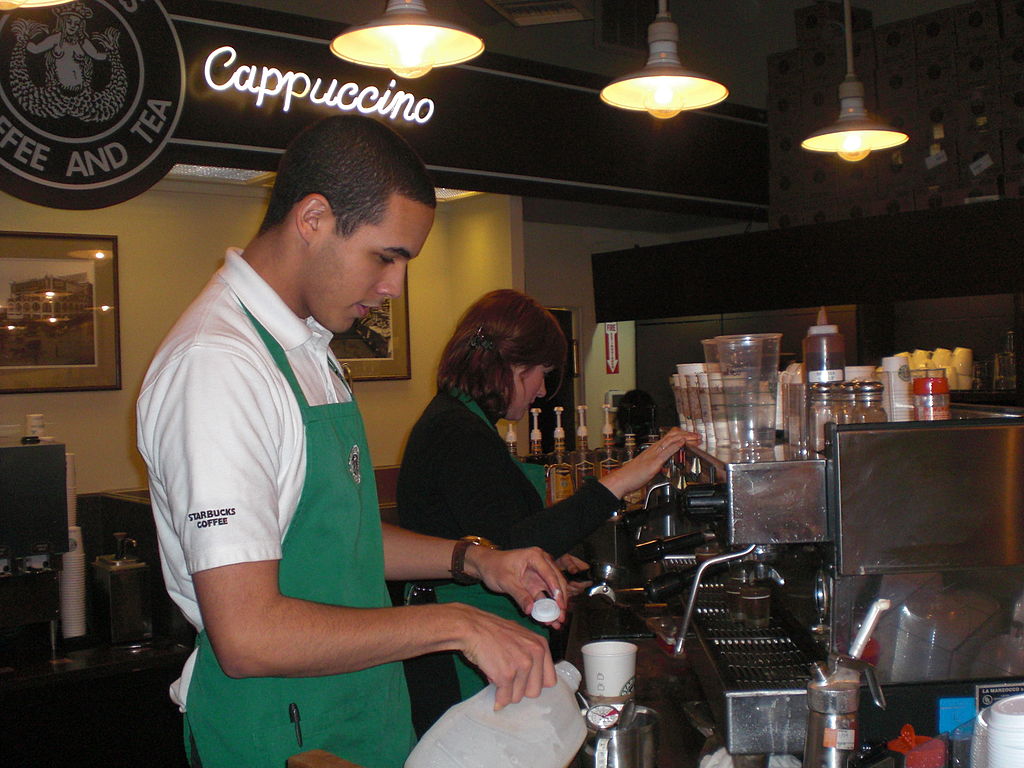
On a bitterly cold day, Josh, like many other teenagers, traveled many miles to get to the coffee shop, where he works part-time. Despite experiencing car troubles, nearly having a car accident, and spending hours in heavy traffic, he arrived at the coffee shop only to do a double shift, carry heavy loads of garbage in the cold, and deal with a hectic day of selling hot beverages to demanding customers.

Even though his school was in session, he chose to come to work instead of going to class at the local college, where he is getting his degree in theater and humanities. When I asked him why he chose his work over his studies, he told me they need him here: “Nobody notices when I am not [in class].” Unlike at school, they notice him at work. He feels needed—like a hot cup of cocoa on a cold day.

Josh, like many other teenagers, works “part-time” while still in school, but do not be fooled by what he calls part-time work. “Part-time” sounds like a few hours of work scattered throughout the week, but he was at the coffee shop every day of the past week. Even on the days when he was not scheduled to work, he stopped by to hang out with his friends. He did not just stand idly by; he also helped the friends who were working.

Read More

piano-315012_1280by Kim de Laat

Postbureaucratic work environments are flexible, project-based settings characterized by consensus-building. They are often hailed as an improvement over the rigid job hierarchies and inflexible working conditions found in most white collar and manufacturing sectors.

Unlike traditional forms of product manufacturing, postbureaucratic work settings, such independent contracting, website design and film projects, can involve a creative process that is unpredictable. The final output is often the result of decision-making processes that are negotiated on the fly (for example, Robert De Niro’s improvisation of the line, “You talkin’ to me?” in Taxi Driver or the Beatles’ use of some accidental feedback at the beginning of ‘I Feel Fine’). In addition, the temporary nature of much postbureaucratic work, particularly in creative industries, creates uncertainty. One’s next paycheck is never guaranteed, and so there is a constant need to pursue work opportunities. It falls on the individual to maintain relationships and ties that can lead to future job opportunities. An unruly creative process and the individualization of risk means that teamwork and cooperation are especially important in postbureaucratic work projects.

Read More