Hair_Salon_Stations

by Kristen Barber

When I explain my research to people, they often ask: “What is a men’s salon, exactly?”In a fleeting interaction I might simply describe it as a salon dedicated to the primping and preening of men. The high-service men’s salons in my study tout stylish haircuts, fine manicures, exfoliating facials, and meticulous waxing services. But to more accurately explain what a men’s salon is involves understanding that gender is actively produced, not a static characteristic of a person or place.

In my article, “Men Wanted”: Heterosexual Aesthetic Labor in the Masculinization of the Hair Salon, I tackle the organizational efforts that make the salon an “appropriate” place for well-to-do, straight, and often white men. This is significant since the salon is historically associated with women and seems an unlikely place in which men can approximate culturally valorized forms masculinity.

One way both salons in my study masculinize the space is by demanding what I call heterosexual aesthetic labor from the mostly women workers. Aesthetic labor highlights the importance of workers’ appearances and use of their body in frontline service work, where employees interact face-to-face with customers. Workers are hired because they embody the aesthetic values of a retail brand, with white, middle-class workers, for example, reflecting the identities of white, middle-class consumers. This assures consumers they are in the “right place” for people like them and is a key mechanism in reproducing social differences and inequalities.

Read More

Neumann1

by Pamela Neumann

Why do so many people put up with highly contaminated living conditions? Conventional academic wisdom suggests that many communities do not protest environmental degradation because they are afraid of losing their jobs. They trade their health for the promise of employment.

My recent research in the Peruvian town of La Oroya, which is plagued by dangerously high lead levels, questions this dominant framework for understanding community responses to environmental hazards.

Instead, I argue that many residents’ reluctance to protest against pervasive lead contamination is tied to deeply held perceptions and beliefs about their town’s identity, and particularly a desire to protect their community from perceived outsiders. While material incentives do drive social action (or inaction) at times, it is also imperative to analyze how localized cultural processes—such as how people make sense of their own surroundings—contribute to the dynamics of social mobilization, as well as the reproduction of economic and environmental inequalities.

Read More


9053798873_5c18fe1753_b


It is difficult to speak to a discipline like sociology, which has a diverse set of interests and various approaches to study society. However, Kevin Leicht’s recent post on this blog did just that and very successfully. The last time I checked, the post had been shared more than 200 times on Facebook. Many sociologists find his diagnosis of our intellectual illness accurate as well as brave and refreshing.

Leicht argues that, in an era of hyper-inequality, the study of inequality should shift away from between-group inequality to within-group inequality; from education to jobs and labor market institutions; from a narrow focus on diversity and sensitivity to an emphasis on the divide between haves and have-nots.

I think Leicht’s prescriptions are right on the money, especially at a time when Donald Trump gains increasing support from working-class Americans and Hilary Clinton called half of his supporters “a basket of deplorables.”  Indeed, one can argue that the current hyper-inequality began in the 1970s when the Democratic Party started to embrace college-educated professionals over their traditional blue-collar workers as their main constituency. Working-class Americans, lured by the Republicans with nationalism and the “Cultural War,” began to vote against their class interests.

But Leicht’s diagnosis does not cut deep enough.

Read More

k10633

by Heather A. Haveman

How did a magazine industry emerge in the United States in the eighteenth century, where there were once only amateur authors, clumsy technologies for production and distribution, and sparse reader demand?  Why would anyone launch a magazine-publishing venture under such circumstances?  What legitimated magazines as they competed with other media, such as newspapers, books, and letters?  And what role did magazines play in the integration or division of American society?

My new book, Magazines and the Making of America, investigates how, over a 120-year period, magazines and groups they connected ushered America into the modern age.  It reveals how magazines fundamentally transformed the nature of community in America.  The signature modernizing talent of magazines, like other media, is to connect people – to literally mediate between them, to facilitate frequent interactions between them even when they are geographically dispersed and would otherwise never meet face to face.

Magazines in this era supported many distinct, cohesive, translocal communities – collections of people with common interests, values, principles, ideas, and identities who were often situated far away from each other.  As America became socially differentiated, magazines engaged and empowered diverse communities of faith (in a burgeoning number of religious groups), communities of purpose (in a wide array of social-reform movements), and communities of practice (in commerce, agriculture, and specialized occupations such as medicine and law).

Religious groups could distinguish themselves from others and demarcate their identities.  Social-reform movements could energize activists across the country to push for change.  People in specialized occupations could meet and learn from one another to improve their practices.  But countering their modernizing effects, magazines also supported many communities of place, which embodied traditional localistic reactions to the rise of modern translocal communities.

Read More

prison-370112_1920

by Brett C. Burkhardt

The US Department of Justice has announced a plan to end its use of private prisons. Last week, the Department issued orders to the Bureau of Prisons to allow extant contracts to lapse without renewal and to cease future requests for new contracts. The plan will reduce the number of federal inmates in private prisons to roughly 14,000 by 2017, down from nearly 30,000 in 2013, and eventually bring the population to near zero.

That said, the plan will actually leave the majority of private prison contracts untouched, and is also likely to mean that private prison providers will push even harder for contracts for the detention of immigrants.

Read More

construction-642631_1280

by Tessa Wright

Women have entered the labour market in huge numbers in recent decades and now match men’s levels of participation in many previously male-dominated occupations such as law and medicine. Yet in sectors such as construction and transport, there has been very little change in the gender balance in the UK, with women accounting for just 1% of those in the manual trades, 12% of professional construction jobs, and around a fifth of those in transport occupations.

One of the reasons why this matters is simple – pay. As I document in my recent book, Gender and Sexuality in Male-Dominated Occupations, Liz was one of several women who chose to go into bus driving because “with a male-oriented job you get male-oriented pay.”

In choosing traditionally male work over less-well paid female-dominated retail or caring occupations, these women were challenging the common pattern of segregation of women and men into different occupations, which is one of the primary causes of the persistent gender pay gap (on average women still receive 9% less than men’s hourly pay, or 19% less when part timers are included).

Read More

Fightfor15

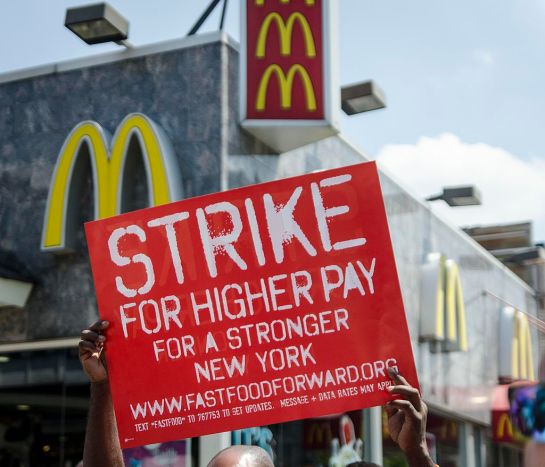
by Christine Williams

I was recently on a plane and sat next to a young woman who was returning to college for her sophomore year. During the flight, she pulled out a sandwich shop’s menu and started putting the names of sandwich combinations on index cards. Naturally, I asked her what she was doing and she said that she was starting a new job at a fast-food restaurant chain the next day. She was studying to make a good first impression.

But after talking to my seatmate, I am convinced that these jobs are a bad choice for college students today. The young woman told me that she depended on her job to make ends meet. Her college expenses were beyond her family’s means.

Jobs in the fast-food industry are a common choice for college students. For many, including me, it is their first job experience.

Read More

Life

by Lata Murti

My eight-year-old daughter received the classic Hasbro Game of Life as a holiday gift this past year.  What caught my attention right away while playing the game with her were the salaries.

All the “College Careers” – those requiring a college degree – started at $80,000 each payday, with teachers making a whopping $100,000 each payday!  I saw on the box that kids chose the careers for this latest version of the game, and I began to wonder if they chose the salaries too.  That might explain the inflated salaries.

After all, in a culture and society that often asks kids to imagine what they want to be when they grow up but seldom how much they want to make, how would a kid determine the salaries of common careers?

For that matter, how does an adult determine the salaries of common careers?  Pay secrecy – or a taboo against revealing one’s salary – is the norm in both US institutions of employment and US society at large.

Indeed, although U.S. employers cannot legally prohibit employees from discussing their pay, many employers implement a formal or informal policy against employees discussing their salaries.  Such policies help employers maintain complete control over wages, thus preventing employee demands for higher pay and wage equality, according to a 2015 study by Jake Rosenfeld and Patrick Denice, two of the few sociologists to study pay secrecy.

In other words, pay secrecy is essential to capitalism, which, at its core, is about unequal wages.

Read More

Grads

by Nicole Deterding and David Pedulla

Between 1990 and 2010, the number of for-profit postsecondary institutions in the United States more than tripled, to over 1,100. This rapid rise of for-profit colleges and universities was a sweeping change in the U.S. higher education landscape, particularly for students seeking two-year degrees and employers wishing to hire college graduates without a bachelor’s degree.

Given this monumental change, how do employers evaluate credentials from new educational institutions?

Two recent field experiments have examined employer responses to for-profit and non-profit credentials. These studies sent experimentally manipulated job applications – randomly assigning applicants either a for-profit or non-profit degree – to apply for real job openings. Neither study found a measurable difference in employers’ responses to job candidates who report an associate’s degree in business from a for-profit institution compared to one with an associate’s from a nearby community college.

While this work offers convincing estimates of how employers respond to job applicants with associate’s degrees, it leaves open questions about why employers don’t appear to register a difference between these institution types.

Read More

Outsourced

by Kevin T. Leicht

Sociology is at risk of losing what credibility it has because we have latched onto ways of studying inequality that are not suited to new economic arrangements.

What are those ways? They started as truths that now represent half-truths or worse – we just repeat them and think we’re doing something to produce insights into how inequality is produced and maintained.

We can’t end inequality by closing group gaps

Let’s start with the most basic of these habits and beliefs – The belief that most social inequality is tied to race and gender. Empirically this is not true and it hasn’t been for at least thirty years.

There is far more social inequality within demographic groups than there is between them.

There is overwhelming evidence to support this claim. The ratio of mean household income in the top 5 percent to the mean household income in the bottom 20 percent within racial groups has grown from 4 to1 to 11 to 1 from 1970 to 2014. Gini ratios – a common measure of income inequality – have increased uniformly for all racial/ethnic groups and converged. From 1970 to 2014 gender and racial gaps in income have been closing. Gender gaps have closed in part because men’s real earnings have fallen, not because women’s earnings have risen.

We can’t educate our way out of the inequality

But this isn’t the only bad habit we’ve fallen for. We’ve also been sucked into the myth that extreme inequality is mostly about educational opportunities.

Read More