by Julie A. Kmec, Lindsey T. O’Connor, and Scott Schieman

President Obama’s State of the Union address last month recognized that working women—and men—should not face hardship for taking care of their family responsibilities.Recent research by sociologists,Julie A. Kmec, Lindsey Trimble O’Connor and Scott Schieman suggests that workplaces have a long way to go before realizing the President’s message.  In new research, they find that working mothers perceive penalties—like feeling ignored and that they are given the worst tasks—when they adjust their work schedules after having children.  They suggest that policies and practices that challenge societal assumptions about ideal work are a good starting place in attempts to realize President Obama’s call to give working parents a “break.”
Read More

Over the weekend, Nicholas Kristof wrote a widely read piece asking where the public intellectual has gone. For those of you who may have missed the editorial, Kristof argues that the culture of PhD programs and the tenure process have forced the academy inward, celebrating dense prose published in little-read, high-priced journals. He notes that academics have been slow to embrace blogging and the use of social media platforms. Kristof also argues the research academics produce has far fewer consequences or conclusions for policy and the public than it has in the past, meaning that the “public intellectual” is a dying breed.

Almost immediately, the various public intellectuals that Kristof couldn’t find took to their blogs and Twitter accounts with gusto, reminding him and us that there are indeed many academics that have made a point of sharing their work on public platforms. Perhaps my favorite response comes from a guest post at Tenured Radical. The writer argues that, as a public university professor, she works as a “public intellectual” every day of the week. Kristof has re-tweeted many of the critiques, creating a running dialogue about his piece on his Twitter feed.

Read More

While the first flight attendants were male and many early airlines had a ban on hiring women, flight attending would eventually become a quintessentially female occupation.  Airline marketers exploited the presence of these female flight attendants.  Based on my reading — especially Phil Tiemeyer‘s Plane Queer and Kathleen Barry’s history of flight attendants’ labor activism — there seem to have been three stages.

Read More

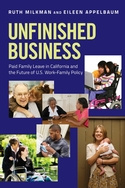
AppelbaumUnfinished Business: Paid Family Leave in California and the Future of U.S. Work-Family Policy by Eileen Appelbaum and Ruth Milkman (Cornell, 2014).

This book analyzes the history of California’s decade-old paid family leave program, the first of its kind in the United States, which began operating in 2004.  Based on original fieldwork and surveys of employers, workers, and the larger California adult population, it analyzes the impact of paid family leave on employers and workers in the most populous state in the U.S., and explores the implications for crafting future work-family policy for other states and for the nation as a whole.

Read More

Happy new year!

Here are the top five most viewed posts of 2013.

1) Storytelling and the Myth of Reverse Discrimination by Kevin Stainback

2) A Luddite, An Economist and a Marxist Walk Into a Modern Factory … by Matt Vidal

3) Early Childhood Education: No Place for Men? by Lata Murti

4) Work-Family Conflict is Not the Problem. Overwork Is. by Robin J. Ely and Irene Padavic

5) College Professors Have the Least Stressful Job? Ask a Sociologist Who Studies Work by Adia Harvey Wingfield

social-mediaWe–fellow Work in Progress Blogger Adia Harvey Wingfield and I–recently attended a summit centered on Redesigning and Redefining Work. This summit, organized by the Clayman Institute for Gender Research at Stanford University, had lofty goals:  to join academic researchers, government policy makers, members of the media, and company representatives to discuss, among other things, new ways to redesign the world of work so that workplaces can better align—for the long term—with the composition and needs of today’s workforce while at the same time allowing workers and businesses to flourish.

The summit focused, among other things, on how flexible work arrangements have the potential to change work environments in ways that produce greater gender equality. Presenters from corporate and academic sectors considered the ways that these programs have been implemented, barriers to implementation, successes, challenges, and benefits.  The program offered a number of different perspectives on ways that flexible work arrangements can have multiple, expected, and possibly surprising benefits for workers and for corporations.

We wanted to share our personal observations of the summit, whose agenda can be found here, because we feel that sociologists of work should be keyed into the discussion of redesign.  We also think the public should be aware of—and join in via commenting here—work redesign discussions happening in academic, workplace, and policy circles.

Read More

anchormanGlasgow in Scotland is a wonderful city. If it’s puffed neighbour Edinburgh is a city to visit, Glasgow is a city to live in. Before he died in tragic circumstances Scotland’s first First Minister in its new Parliament, Donald Dewar, described it as a handsome city. Indeed in recent years Glasgow has been named UK City of Architecture and Design, and a few years earlier European Capital of Culture. In 2014 it hosts the Commonwealth Games (think summer Olympics for the countries of the old British Empire). It’s all part of the repositioning of a city that was once an industrial heartland for Scotland and that empire.

In recent years that repositioning Read More

Low wage, bad job

Low wage, bad job

It might not have been springtime, but Paris in late autumn is still beautiful. I was invited there to participate in an international conference on the quality of work. Unbeknown to me, my session had been informally labeled by one of our hosts as ‘Bob Dylan vs The Beatles’. The focus was interventions to improve job quality. Bob Dylan was Paul Osterman from MIT. If they were drawing on a Beatle analogy, I was hoping our hosts thought of me as John Lennon and not Paul McCartney: more working class hero than singing frog. The billing though reflects more than our differing US and UK origins; Paul Osterman and I have competing opinions about how to fix job quality and make it better.

Read More

US inequality

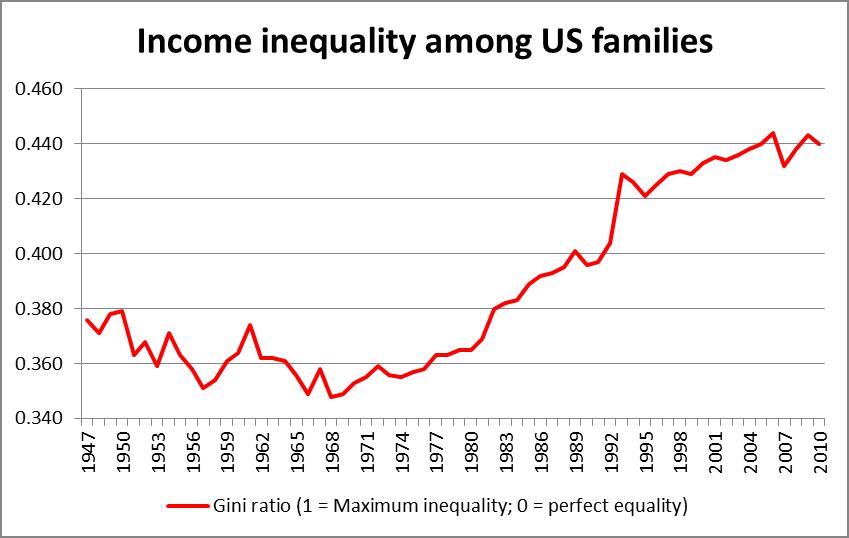
Rising income inequality in the United States has become big news over the last few years. Sociology and left political economy have always seen inequality as a structural outcome necessarily produced by the normal operation of capitalist economies. The recent concern shown by mainstream economists and some politicians is more curious, given that – with the exception of a three-year period in the 1990s and again in the 2000s – income inequality has risen steadily from 1968 to the present.

Read More

by Erin L. Kelly and Phyllis Moen

Overworked? Overwhelmed? You’re not alone. Seventy percent of employed Americans say work interferes with their non-work lives. Over half feel they don’t have enough time with their children or spouses. This isn’t just one group: it’s mothers, fathers, married workers, singles, Boomers, GenXers and Millennials.

“Work-life balance” has been discussed for 40 years and many companies have tried to address the issue. Seventy-seven percent of workplaces with more than 50 employees allow some employees to change their schedules and 63% allow some regular work to be done at home. Unfortunately, flextime, telecommuting and shifting to part-time hours are usually provided as “accommodations” to help a few employees.

The root problem, of course, isn’t that employees have family or personal commitments. The root problem is the rigid conventions of work that assume work must occur at certain times and places and that mistakenly gauge productivity by the number of hours spent at work.

Read More