One remarkable development, just aired live on line, concerning the administrative turmoil at the University of Virginia: the university’s board has relented, admitted its procedural misstep in ousting President Teresa Sullivan, and unanimously voted to reinstate her. She will therefore retain her position as President of the University. Terry is known to many of us as an accomplished sociologist of work and a visionary administrator. She will now have the ability to continue on in her appointed role. As I type, Sullivan is making a statement about this whole series of events and her hopes for the university in the coming years.

Obviously, this whole episode has raised any number of issues about the future of higher education: the bearing of institutional traditions on administrative decision making;  the right of various constituencies (students, faculty, deans) to participate in critical decisions about university strategy; and the relation between business thinking and the ideals of the liberal arts today. It also draws attention to the threats that higher education faces so frequently today, with Cassandra-like calls for urgent restructuring in ways that are sure to limit the space on which critical inquiry depends.  Had UVA students, faculty, 33 department chairs, and 10 deans not formed common cause in support of their institution’s mission, an autocratic process would surely have prevailed. To my mind, the threats facing American universities would have grown that much more pronounced.

There will be much coverage and commentary about this event; see the Washington Post for further reporting. Feel free to post comments on this whole affair –and on the changes convulsing your own institution.

UVA Faculty Senate convene in an emergency session, June 17, 2012

Many of us in OOW study the social organization of higher education, the emergence of the knowledge economy, or the growing influence of corporate logics on university campuses. So it is particularly ironic that we face a highly significant case involving the dismissal of the most administratively accomplished sociologist of work in the United States. I’m referring of course to the ouster, eight days ago, of Dr. Teresa Sullivan, a sociologist and a leading administrator. As the former Dean of Arts and Sciences at the University of Texas Austin, former Provost at the University of Michigan Ann Arbor, Sullivan brought a distinguished record into her term as President of the University of Virginia. All of us who know her, however obliquely (as in my case) perceive a razor sharp intellect, a self-effacing human being, and an inspiring instructor. (She continued to teach the sociology of work even while serving as UVA President.)

All of which would have provided the basis for pride –that is, until June 3rd, when UVA’s Board summarily announced Sullivan’s resignation. In truth, she’d been forced out under highly questionable circumstances, sending the campus into a roiling controversy ever since. The upshot? Powerful donors have called for an end to gift giving unless those who ousted Sullivan are sent packing. The university Senate held an emergency meeting on June 18, for the purpose of taking a no- confidence vote against the leaders of the University Board (in Virginia parlance, the Rector and Vice-Rector). Thirty-three department chairs wrote a letter to the Rector, protesting Sullivan’s summary dismissal and asking for her return. Even the sitting Provost of the university publicly distanced himself from the Board’s actions, expressed his ethical distaste for the process they invoked. Much if not most of the public commentary and debate has involved demands for Sullivan’s return and indignation at the treatment she and the institution have endured.

So why should non-Virginians care? The answer lies in the clash of visions that led to Sullivan’s ouster. Though the details are still somewhat murky –the Board has refused to give any account of the issues that led to their actions—some clarity is beginning to emerge, partly thanks to the Washington Post’s detailed coverage of this case, partly from leaks and statements of UVA faculty (see the insightful article by UVA scholar Siva Vaidhyanathan, in Slate magazine), and partly from the strategic vision memo that Sullivan wrote roughly six months ago. What all of this material suggests is that UVA has been the site of an intense organizational struggle for the soul of the modern public university. Those who forced Sullivan out –a billionaire hedge fund manager and a wealthy real estate developer— seem to hold a vision of the university that relegates the liberal arts to the periphery of the campus, while placing market-friendly organizational logics at the core of UVA’s operations. For her part, Sullivan sought to strengthen the historic foundations of the university, adapting its long-standing commitments in ways that comport with 21st century realities. Here, in other words, was a clash between two opposing entities: On the one hand, a small group of aggressive and ambitious businesspeople, appointed by yet another right-wing governor, seeking to remake UVA in their own image; and on the other hand, a staunch advocate of the liberal arts tradition that has served UVA so well for generations.

Questions abound. Is this higher education’s Wisconsin moment? Can the Board of Visitors prevail, in spite of growing opposition from students, faculty, donors, and alumni? If so sudden and arbitrary a change in an institution’s core mission can happen at the University of Virginia, what does that portend for less well endowed and less privileged institutions? What will happen to our own workplaces, in other words, if so venerable an institution can be lurched in a direction that is alien to its mission?

Sociologists of work organizations who wish to express their views of this case might want to send messages directly to Dr. John Simon, the Provost at UVA (jwt5z@virginia.edu). And of course, please feel free to post a comment on this case directly to the OOW blog, especially as these events unfold.

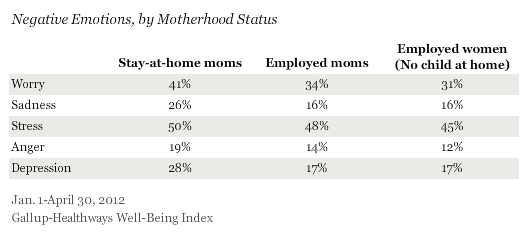
The New York Times’s Economix Blog had a post on Friday that summarized some interesting new polling data from Gallup. In light of our recent panel on the gender wage gap and the role of “choice” in individual decision making around staying at home vs. working, I thought it would be good to share some quick highlights here.

Among the most interesting findings is that stay-at-home moms reported higher rates of worry, sadness and depressed emotions than their employed counterparts (both with and without children).


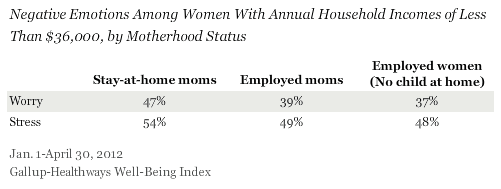
This varies by income level, with mothers in households that earn less than $36,000 annually expressing higher rates of worry and stress than their employed peers.

My take away is not that being a stay-at-home mother is intrinsically bad for your mental health. Rather, it may be that the stressors associated with being a stay-at-home mother are such (for some women) that their mental health suffers in comparison to their employed peers. These stressors are likely complicated phenomena with a diverse range of etiologies. Unfortunately, the Gallup report does not go into any follow-up questions that were asked, so we aren’t given a good picture as to why women felt this way.

A couple caveats – these are self reported mental health evaluations, not evaluations by mental health professionals. They are also only descriptive statistics, with no included difference of mean measures or the like. Gallup reports that these data are drawn from a sample n of 60,000 and have a maximum margin of sampling error of +/- 1% (95% confidence).

The continuing presidential campaign in the United States has been dominated by a number of noticeable trends, including contentious debates about reproductive rights specifically (what some have called the “war on women“) and, more broadly, about gender roles in American society (think about the recent commentary on Ann Romney, a topic Adia has blogged about). There has also been much discussion about the state of the economy in the United States and continuing issues of un- and under-employment (see my posts here and here).

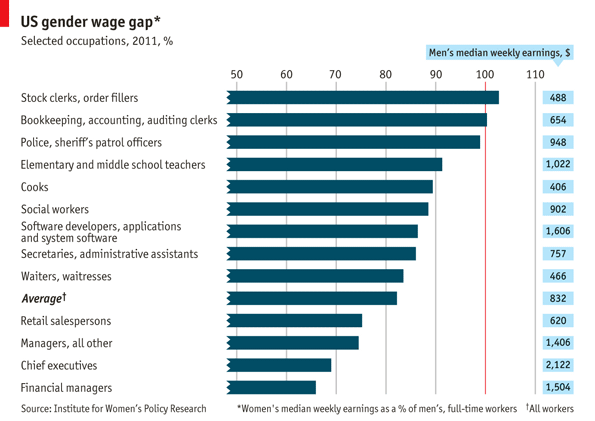
An important intersection of these two political debates is the counting disparity in pay by gender. A recent article in The Economist, citing work done by the Institute for Women’s Policy Research, documented this phenomena, noting that women continue to earn, on average, 82.2% of what men earn. This gap, as the graphic below shows, varies considerably by occupational category.

Image via The Economist (April 17, 2012)

In the following three pieces, our regular bloggers Adia Harvey Wingfield and Julie Kmec join guest blogger Rebecca Glauber in dissecting some of the causes and debates surrounding the gender wage gap, both within and outside of sociology.

I’ve been using a lot of air quotes in my classroom discussions, and I’m finding it a bit troubling. Not just because the quotes date me to the late 1990s, but also because they are inadequate stand-ins for something that needs to be said. Those gestures you make by your ears that slip out with little warning, shooting up from your hip mid-sentence as if to add irony, complexity, and intrigue. Women’s and men’s “choices” in work. Women’s and men’s “choices” in family.

Read More

A recent WSJ article by Kay Hymowitz (Why Women Make less than Men, April 26, 2012 ) reports that “most people have heard that full-time working American women earn only 77 cents for every dollar earned by men. Yet these numbers don’t take into account the actual number of hours worked. And it turns out that women work fewer hours than men.” Hymowitz continues, citing Labor Department statistics indicating more than half (almost 55%) of workers who work more than 35 hours per week (what the department defines as full time work) are men and suggests that the sex wage gap is “to a considerable degree a gender-hours gap.”

Read More

Julie and Rebecca have cited important sociological analysis that documents the fact that net of hours worked, the gender wage gap remains such that men still outearn their female peers in the same occupations. One other piece of commonsense wisdom often cited to explain the wage gap is the argument that women select occupations that tend to be lower paying—teaching, nursing, and other positions that we tend to associate with women. According to this line of reasoning, women are more likely to self-select into the “feminized” positions within certain fields, which then contributes to gender inequality in the labor market.

Read More

Apple Inc. is the largest technology company in the world, in terms of both revenue and profit. Yet, the California-based company has just 47,000 workers on its payroll in the United States. Apple recently released a report in which it claimed responsibility for “indirectly” creating an additional 257,000 American jobs in industries that are part of its supply chain, a claim that was “disreputable,” in the words of MIT labor economist David Autor – as if Apple’s suppliers did not have any other customers. Or, as Wharton labor economist Peter Cappelli noted, as if the consumers spending their money on an iPad would not have purchased another product in its absence (see a New York Times article on debates over the report here, including comments from Autor and Cappelli).

While Apple’s claim to have created jobs for UPS and FedEx employees is questionable, however, there is some truth to the argument that Apple is responsible for the employment – and working conditions – at its key suppliers, particularly manufacturers for which Apple is the main customer. This may be the case for some Corning employees in the US (supplying glass for iPhones) and is very likely the case for, tens, perhaps hundreds of thousands of employees at Foxconn in China, which presumably has entire lines or buildings dedicated to Apple.

A recent report by political economist and accountant Karel Williams and his research team at the Centre for Research on Socio-Cultural Change at the University of Manchester looked at the Apple Business Model and its employment effects. They cite a study which found that Chinese workers add $6.50 in value to each iPhone 3, just 3.6% of the phone’s shipping price.

Read More

A few days ago, the top story on Huffington Post was an article titled “Women’s Jobs Axed by State Austerity Politics.” The piece argued that as public sector jobs are decreasing, women are disproportionately the ones losing work as many of the jobs that are affected by budget cuts—teaching, providing child care—are those that are typically filled by women. Inasmuch as jobs tend to be sex segregated, the female dominated jobs in the private sector that women tend to occupy (administrative services, secretarial work) are not in high demand, leaving women in a position where the sort of jobs in which they tend to be concentrated are declining or even disappearing.

Read More