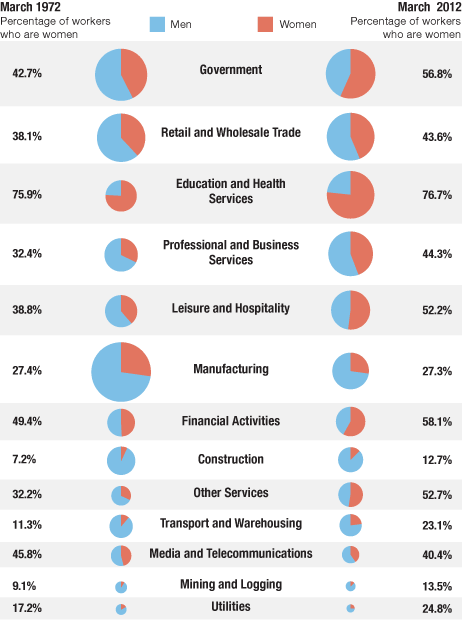
 Matt Vidal’s recent posting raised a number of important issues. One he did discuss is the role of gender—namely the way it patterns where you work—in manufacturing employment.
Women in Manufacturing: Watch out for Mr. Roboto
Leave a comment
Matt Vidal’s recent posting raised a number of important issues. One he did discuss is the role of gender—namely the way it patterns where you work—in manufacturing employment.
Even after years of studying gender as a sociologist, I was not prepared to see a man in the infant room on my daughters’ first day at a new child care center in August 2011. I assumed the man was a dad. When my three year old happily introduced me to “Teacher Adam” the next day, I realized that he was the first male child-care worker I had ever met (thus, my Biblically-based pseudonym for him– “Adam”). I left the center very pleased that my family had chosen a seemingly progressive child-care facility in the small California city to which we had just moved.
I soon found out that not all of the parents or female staff were so pleased. These staff and parents believe that men should not care for small children, especially infants, in a child-care facility, and that any man who wants to do so is a pedophile. Thanks to their beliefs, Adam, the only man ever to be hired in the 25 year history of my daughters’ child-care center, no longer works there. In fact, he will no longer be able to work with children ever again.
Both men and women experience job discrimination when occupations are closely associated with either masculinity or femininity. In my research on “men who do women’s work,” I found that men are often excluded from occupations that involve close contact with children due to stereotypes about male sexuality and suspicions of pedophilia. Homophobia is often at the core of these damaging and destructive stereotypes.
Partially because of these stereotypes, men constitute only 2-3 percent of all preschool and kindergarten teachers. However, those who remain in the occupation seem to do pretty well. Data on median weekly earnings indicate that men out-earn women in this occupation by a sizeable amount—more than $700 compared to women’s $600. (However, note that the occupation as a whole is woefully underpaid—no one is exactly thriving in these mostly dead-end jobs!)
So men are both discriminated against AND they earn more money than women. How can we make sense of this paradox?
By Barbara J. Risman, Professor and Head, Department of Sociology, University of Illinois at Chicago
There is no debate about the remarkable lack of men as child care workers. This occurrence of apparent gender stereotypes driving one man away from the profession illustrates some core issues in the continuing saga of a somewhat stalled gender revolution. Another illustration of the state of current gender politics is a Stanford educated lawyer, once her husband’s mentor in a law firm, describing herself as the mom-in-chief.
Like Lata Murti, I, too, have been thinking, teaching, and writing about men and women at work for a long time, and my initial reaction to her story is one of regret for Adam. Nearly simultaneously, though, I think about my own daughter and what my spouse and I expect of the people who care for her. When I look back at the history of her baby-sitters, the majority of them (all but one) were women. And when I’m honest with myself, I’m not sure I can dismiss the possibility that each of those independent decisions was gendered in some way.
 Did you know that know that employment decisions based on the assumption that men are breadwinners can be just as illegal as those that assume women are caregivers? That penalties men experience as a caregiver can be illegal under Title VII? If you’ve ever wondered what gave rise to men’s legal right to provide family caregiving and how was written—and subsequently unwritten—into law , read law professor Stephanie Bornstein’s recent publication.
 In light of the recent panel on the gender wage gap, I thought it would be useful to talk about the data access implications of recent blockage of the Paycheck Fairness Act.
I’ve been using a lot of air quotes in my classroom discussions, and I’m finding it a bit troubling. Not just because the quotes date me to the late 1990s, but also because they are inadequate stand-ins for something that needs to be said. Those gestures you make by your ears that slip out with little warning, shooting up from your hip mid-sentence as if to add irony, complexity, and intrigue. Women’s and men’s “choices” in work. Women’s and men’s “choices” in family.
A recent WSJ article by Kay Hymowitz (Why Women Make less than Men, April 26, 2012 ) reports that “most people have heard that full-time working American women earn only 77 cents for every dollar earned by men. Yet these numbers don’t take into account the actual number of hours worked. And it turns out that women work fewer hours than men.” Hymowitz continues, citing Labor Department statistics indicating more than half (almost 55%) of workers who work more than 35 hours per week (what the department defines as full time work) are men and suggests that the sex wage gap is “to a considerable degree a gender-hours gap.”
Few pastimes are perhaps more uniquely American than going to the movies. Though movie prices continue to increase from their already elevated prices, feature films are fairly accessible for most Americans; they reach a diverse and widespread audience, whether viewed in the theater, at home, or, in today’s technology-driven, ask-and-you-shall-receive society, through instant online streaming via iTunes or Netflix.
Inarguably, blockbuster films often serve as powerful theatric representations of both contemporary and historical social problems and injustices. Through fictional yet theatrical and artistically visual means, popular films have captured the imaginations of millions of Americans, establishing a platform upon which conversations about political and social issues—both in the media and amongst citizens—can and have taken root. Don Cheadle’s 2004 performance in Hotel Rwanda, Sean Penn’s portrayal of gay rights activist Harvey Milk in 2008’s Milk, and 1994’s Philadelphia, which tells the story of Andrew Beckett (played by Tom Hanks), an HIV-positive attorney who is fired on the basis of his medical condition, are all movies that have sparked politically charged conversations about race, sexuality, inequality, and civil rights in the United States.
 Work in Progress