Archive

Author Archives: Guest Contributor

Intertemporal_Choice

Source: Wikimedia Commons.

by Philip Cohen

There is a lot to be said for the common critique of economists: They see society as the product of freely acting, rationally calculating individuals for whom monetary reward is the primary source of motivation. Free markets, to them, are the pure expression of social function and economic growth through their realization is the only outcome that matters.

But people do not simply act rationally to maximize their economic rewards, because they can have incomplete or inaccurate information, ideological biases, conflicting desires or collective interests. Exploitation, dishonesty, violence, ignorance and demagoguery set vast areas of social life apart outside the model. The multiplying exceptions overwhelm the rule bringing the model’s utility into question.

Read More

economic-policy-744x570

Source: Money, by 401(K). CC-BY-SA-2.0 via Flickr.

by Elizabeth Popp Berman and Daniel Hirschman

There’s a puzzle around economics. On the one hand, economists have the most policy influence of any group of social scientists. In the United States, for example, economics is the only social science that controls a major branch of government policy (through the Federal Reserve), or has an office in the White House (the Council of Economic Advisers). And though they don’t rank up there with lawyers, economists make a fairly strong showing among prime ministers and presidents, as well.

But as any economist will tell you, that doesn’t mean that policymakers commonly take their advice. There are lots of areas where economists broadly agree, but policymakers don’t seem to care. Economists have wide consensus on the need for carbon taxes, but that doesn’t make them an easier political sell. And on topics where there’s a wider range of economic opinions, like over minimum wages, it seems that every politician can find an economist to tell her exactly what she wants to hear.

So if policymakers don’t take economists’ advice, do they actually matter in public policy? Here, it’s useful to distinguish between two different types of influence: direct and indirect.

Read More

Nytimes_hq

Source: Wikimedia Commons

by Philip Cohen

The economist Justin Wolfers, writing for the New York Times Upshot, reports that economists increasingly outnumber other social scientists in mentions in the both the Times and — even more — in the Congressional Record. About 1% of Times stories use the word “economist,” more than three-times as often as they write “sociologist.” Here’s his figure tracking Times references:

wolfers-nyt-mentions

In the Congressional Record the economist-sociologist ratio is 20-to-1. I’ll show some other numbers, but first a little setup.

Read More

Red-Light-District

Credit: kPluto (Creative Commons: BY-NC-SA 2.0)

by Anthony Marcus, Chris Thomas, and Amber Horning

Many recent public policy discussions about prostitution, especially underage prostitution, invoke disturbing narratives of hyper-violent, predatory pimps luring and coercing young girls into sex slavery. However, three recent studies of underage sex workers and pimps/market facilitators in New York and New Jersey call into question these assumptions. First, these public narratives overestimate the role of pimps in street sex markets; second, they overemphasize the impact of the initial recruitment stage on subsequent practices; and third, they mask or simplify the difficult and complex choices and contingencies faced by minors who sell sex. The studies find that there is in fact no prototypical pimp and relationships are more flexible, dynamic, and particular to the individuals involved than has been previously imagined.

Read More

LBC--_Library_Stacks_and_Tables

Source: Google Images.

by Marianne Cooper

In the fall of 2011, I received an e-mail from Professor Shelley Correll, director of the Clayman Institute for Gender Research at Stanford University. Its subject line read: “An opportunity.” Shelley explained that Sheryl Sandberg, the COO of Facebook, was looking to hire someone to do research for her on women and work and to help translate the research into everyday language for a general audience. This seemed like an intriguing opportunity. I said yes, and a meeting was set up.

At this first meeting, Sheryl and I had a wide-ranging conversation about why so few women get to the top. We talked about structural barriers like gender bias and the lack of flexibility in so many jobs. We also talked about internal barriers such as the fact that women often have lower expectations for success than men. At the end of the meeting, we agreed that I would do a preliminary project and then progress from there. I left with a list of topics she wanted to know more about; on my way out Sheryl said, “It’s important to me that I get the research right.” I took this as a positive sign.

Read More

by Emmanuel Saez and Gabriel Zucman

There is no dispute that income inequality has been on the rise in the United States for the past four decades. The share of total income earned by the top 1 percent of families was less than 10 percent in the late 1970s but now exceeds 20 percent as of the end of 2012. A large portion of this increase is due to an upsurge in the labor incomes earned by senior company executives and successful entrepreneurs. But is the rise in U.S. economic inequality purely a matter of rising labor compensation at the top, or did wealth inequality rise as well?

Read More

Soup kitchen

Source: Wikimedia Commons

by Jonathan Nitzan and Shimshon Bichler

Can it be true that capitalists prefer crisis over growth? On the face of it, the idea sounds silly. According to Economics 101, everyone loves growth, especially capitalists. Profit and growth go hand in hand. When capitalists profit, real investment rises and the economy thrives, and when the economy booms the profits of capitalists soar. Growth is the very lifeline of capitalists.

Or is it?

Read More

Which_way_homeby Herbert J. Gans

The United States, like other modern economies, is experiencing a new and possibly long-lasting era of rising economic inequality, which may result in further political and class inequality. Consequently, sociologists should be asking themselves what roles they and their discipline can play in understanding these inequalities, particularly the societal changes and social costs they are likely to bring.

However, the discipline as a whole also needs to become more relevant to the country, and thereby also make itself more visible and valued. Although the current rise in inequalities is global, the differences in national political economies, and in national sociologies suggest that every country must find its own answers – as long as global implications and consequences are also considered. What follows is my attempt to suggest a more detailed scenario, or a vision of where American sociology should be headed.

Read More

Guysby Kristen Schilt

Recently the New Republic featured a story about how the workplace experiences of transgender men and women can shed light on occupational gender equality more broadly. Jessica Nordell interviewed me for the article, and we talked extensively about the research I did for my first book, Just One of the Guys, that focuses on the work lives of transgender men in Texas and California. I argue in the book that trans men can develop what Patricia Hill Collins calls an “outsider-within” perspective from the unique experience of having worked on both sides of the gender binary. This experience can put into high relief the often-invisible social processes that produce and maintain a workplace gender gap. As many of the men I interviewed noted, bringing their appearances in line with their feeling of maleness could bring a noticeable change in their workplace treatment – a change that one man described as going from “bossy” to “take charge.” However, white and heterosexual trans men reported more positive changes in their treatment from co-workers and employers than trans men of color and gay trans men.

Read More

Domestic worker

Source: International Labour Organization

by Christelle Avril and Marie Cartier

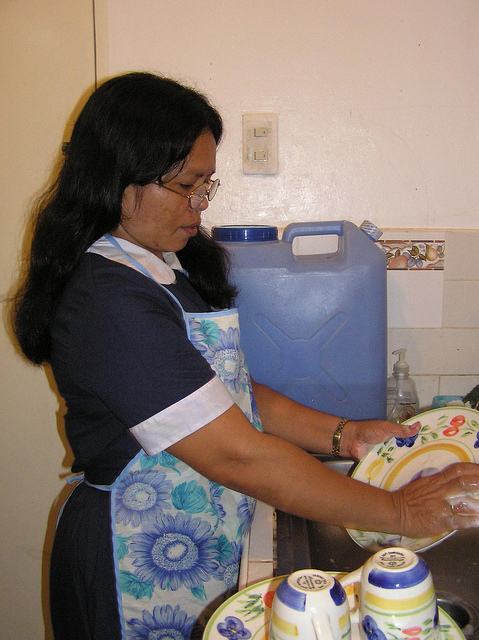
Home-based service jobs have developed considerably across Western societies. In fact, chances are high that a working-class woman in France today will, at some point in her life, be a house cleaner, home-based childcare provider, or home aide for the elderly. Political, scholarly, and everyday discourses, saturated with the double prejudices of gender and class, treat all these home service occupations, which require little prior training, the same. In our article (here), we illuminate the variability of the forms of subordination experienced by women in these occupations in France.

Read More