Archive

Commentary


exploratorium-clip1

Guess which discipline is missing ...

by Fabio Rojas

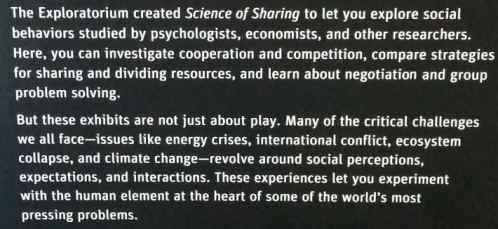
I recently visited the Exploratorium, the children’s “hands on” museum in San Francisco. I had a really wonderful experience. One of the most exciting things about the museum is that it actually has a whole section just on social and behavioral science. Kids can play prisoner dilemma games, a clever experiment about frames and disgust, and there is a fun exhibit on social networks. A+ experience.

The one disappointing aspect of the social science section is that it gives credit to all manner of social scientists… except sociology, even when the material is sociological in nature. The picture above mentions the funder and describes the science. If you are wondering what the sociological content is, it is at least these two exhibits: (a) a large display of global social networks and (b) a clever framing experiment.

Basically, this is another piece of evidence that the public simply doesn’t understand that sociology is the scientific study of groups. They think it is something else, probably inequality studies. We have to keep pushing to make our image fit our discipline.

Fabio Rojas is associate professor of sociology at Indiana University and a founding blogger at orgtheory.net.


combnd

It may seem strange to say, but we academics who study work sometimes get too caught up in the workplace itself. By that I mean that, much like the workers we study, we get so fixated on workplace events and processes that we forget to attend to the sphere of non-work. If we really want to understand the meanings that work acquires, then it behooves us to attend to the messages about work that are increasingly encoded in popular media –most notably, in film and TV. Here we can often find instances of what Paul Willis once called “penetrations,” or insights into the truth about work and inequality that debunk socially dominant myths.

As Exhibits A and B, consider two recent films that center on the struggles that workers confront in this era of neo-liberalism and new technologies. Both films derive their power at least partly from the sites they invoke, which lie at the very center of power and authority in the advanced capitalist nations. In the one case –“Nightcrawler,” starring Jake Gyllenhaal and Rene Russo— we get a vivid account of freelance cameramen trawling for lurid footage of violent crime, which they can sell to local TV stations wanting to jump start their ratings.

In the other case –“Good Kill,” starring Ethan Hawke and January Jones— the film centers on military officers assigned to work as drone operators, ordered to rain Hellfire missiles down at Afghani peasants vaguely suspected of being militants. These films seem on their face to be worlds apart. Yet in truth, both capture deeply troubling situations in which workers are compelled to produce and reproduce the very culture of violence that envelops us in our everyday lives. These films raise far reaching questions of concern to workers generally: What to do when morality and authority diverge –and how to achieve a modicum of agency and autonomy in a system designed to support neither.

Read More

Image: John Keatley via Flickr (CC BY-NC 2.0)

Image: John Keatley via Flickr (CC BY-NC 2.0)

Since I conducted research on manufacturing in the US Midwest in the early aughts, I’ve kept in contact with a few of my informants. One of them, Paul D. Ericksen, has 38 years of experience working in procurement and supply management, primarily in two household-name, multinational manufacturing corporations. Ericksen has been writing a blog on Next Generation Supply Management at IndustryWeek since April 2014, and I’ve been keenly following it.

The Ericksen blog is an object lesson in how wide the gulf is between the everyday problems facing manufacturing managers in the real world and the way academics represent management within mainstream management theory. By mainstream management theory, I have in mind the economistic literature based on assumptions that individuals are rational maximizers and markets are inherently efficient (as opposed to the sociological literature, which emphasizes how cultural institutions and power relations in the real world systematically undermine the maximization of efficiency).

Ericksen worked with many hundreds, perhaps thousands of factories that supplied parts and subassemblies to the Fortune 500 companies he worked for. Based on this experience, he highlights a number of ways in which deeply embedded forms of culture and power, in both the multinational corporate brands (prime contractors) and their suppliers (subcontractors), generate and sustain systematic inefficiencies in their organizations. (For academic studies that document and triangulate such outcomes with the views of other informants, see my colleague Josh Whitford’s book on the decentralization of American manufacturing, as well as my own study of routine inefficiency in factories.)

Read More

Image: keepingtime_ca via Flickr (CC BY-NC 2.0)

Image: keepingtime_ca via Flickr (CC BY-NC 2.0)

This past week, voters in Houston struck down Proposition 1, or HERO (the Houston Equal Rights Ordinance), which would have barred discrimination on the basis of race, age, military status, disability, sexual orientation, gender identity, and additional categories in non-religiously based organizations and institutions.

Several things come to mind in light of the vote.

HERO was drafted by Houston Mayor Annise Parker, certainly not the first female mayor or a major city but the first openly gay mayor of a major U.S. city.  The bill’s opposition could be, in some way, opposition to an openly gay woman seen as “favoring her own,” a barrier many minority leaders face.  While it is rare for straight, white male leaders get accused of passing legislation that benefits other straight, white men, it turns out that women and minorities are deemed as “selfish” and disliked if they attempt to promote other minority groups.

But would HERO have passed if a straight, white man drafted it?  Maybe not because of the way HERO was framed by opponents.

Read More

Image: Picserver.org (CC BY-SA 3.0)

Image: Picserver.org (CC BY-SA 3.0)

by Scott C. Whiteford and Natasha M. Ganem

Searching for the term “leadership” in six key journals published by the American Sociological Association* from 1994-2014 brings up 31 peer-reviewed articles. This stands in stark contrast to the 2,848 papers published by these journals in total. By this measure only about 1% of sociological research is dedicated to leadership.

We have only found one book chapter that addresses the question of what a sociology of leadership might be. In Nohria and Khurana’s (2010) edited Handbook of Leadership Theory and Practice, sociologist Mauro F. Guillén provides a review of classical sociological approaches to the study of leadership yet directly acknowledges too that there is no such thing as a separate subfield of ‘the sociology of leadership.’

We are frustrated by this. Why is this topic off-limits in sociology? Might we consider Leadership as a substantive area in sociology? What would this look like?

Read More

Image: Luigi Mengato via Flickr (CC-BY-SA 2.0)

Image: Luigi Mengato via Flickr (CC-BY-SA 2.0)

Adam Grant, an organizational psychologist at the Wharton School, has an op-ed in the New York Times that describes the decline in workplace friendships. Grant notes that compared to workers in other countries, Americans are much less likely to claim close friends at work or to see the workplace as a social space where close friendships are built. He refers to several important sociological studies in analyzing why this is so, noting that the nature of work has changed so that workers are more likely to switch jobs frequently and thus may not feel a close sense of association with colleagues.

Grant references classical sociologist Max Weber’s theory that Calvinism shaped the perception of work as a place where money is made and emotions are inappropriate. Importantly, however, Grant notes that ignoring the workplace as a site where friendships can blossom may rob us of important opportunities. Jobs can become more pleasant and workers more effective when they work with friends.

This is an interesting piece that has important implications for a work world that has changed significantly, and one where issues of diversity are of paramount importance. Sociologists have documented the myriad challenges that people of color encounter at work—stereotyping, tokenization, difficulty finding mentors, closed socialnetworks, discrimination, and others.

Read More

Image: Walters Art Museum via Google (CC by 3.0)

Image: Walters Art Museum via Google (CC by 3.0)

by Karla A. Erickson

For those of us who are already adults in 2015, we are most likely to die due to multiple chronic conditions in old age. Our lives will be longer and our deaths will be slower than our distant ancestors, our parents, even those who were born just a decade earlier than us. From a labor perspective, our longer lives and slower deaths require many more days, months and years of assistance. Enter the ever-growing labor force of workers I call end-of-life laborers.

The “grey tsuanami,” as some scholars call it, is coming, whether or not we are ready. The United States, like many similar nations, is on the brink of a care crisis. We’ve faced teacher shortages in the past, but our focus in the coming decades will necessarily shift all the way to the other end of life. As scholars of labor, we need to prepare to inform the coming re-direct of attention, labor, policy and practice that will accompany the grey tsunami.

Average life expectancy has risen by 30 years in the last 100 years. The benefits of what I call the longevity dividend are not equal. White females born in 2010 are expected to live almost 4 years longer than their black male counterparts. More than half of the babies born in this decade in advanced industrial nations are expected to live to be 100.

Read More

Image: Jamain via Wikimedia Commons

Image: Jamain via Wikimedia Commons

A few months ago, I spent several days at a conference on a topic that holds great intrinsic interest for me. I signed up for the conference, eagerly anticipating meeting new people and being challenged with novel ideas. I had never attended the conference before and had few preconceived notions about the format for presentations. However, because most of the scholars were in the humanities, I knew that I wouldn’t be seeing many tables of numbers or hearing about esoteric statistics!

What I wasn’t prepared for was being read to. Over the course of several days, almost every speaker read their presentations from pre-prepared scripts. In one typical session, the first two presenters held their papers with two hands, looked up occasionally, and put the paper down only to change the PowerPoint pictures. They read well, using inflection and pitch to emphasize important points, but it was still a word for word matching of oral presentation to the text. The third presenter had a script but had done a better job in memorizing it, as she made occasionally made eye contact with us and did a fairly good job of disguising the fact that she was reading.

As I always try to do in conferences, I had made a point of sitting in the first row, so I could see the slides clearly and also have a clear view of the presenters’ faces. I found that being able to see faces helps me catch meanings I otherwise might miss when I don’t hear all the words.

Despite my advantageous location, where I should’ve been in the thick of the action, there wasn’t any. I found my attention wandering, and to stay focused, I tried taking notes of the key points that I heard. As often happens, my notes quickly became observations on the format of the presentations and not just their contents.

Why couldn’t I stay focused on the content?

Read More

Christmas

Bradley Graupner via Flickr (CC BY-NC-ND 2.0)

by Kenneth Wee and Karla Erickson

“The paradox of education is precisely this – that as one begins to become conscious one begins to examine the society in which he is being educated.”

– James A. Baldwin

In 2011, a Pew Research Center report found that nearly half the American public considered teaching students job-relevant skills and knowledge to be the defining purpose of a four-year college education. While a good three quarters (74%) of college students walk away from their alma mater feeling like they have grown intellectually and personally, only 39% considered that the central aim of their education. As more and more fresh undergraduates regret not gaining more work experience while in school, overwhelmingly major in STEM fields and business, and identify “getting a better job” as a main reason for attending college, the strings that tie education to employment have only tightened.

Ironically enough, the ancient philosopher Plato might offer us the best take on neoliberal education yet: “education is teaching our children to desire the right things.”

Curiously, it was really only after World War II, when breakthroughs in manufacturing technology and expanding global markets brought demand for skilled labor, that American universities and colleges started explicitly seeing education through the lens of occupation. Larger universities like the University of California at Berkeley – whose president Clark Kerr claimed that colleges existed to “produce socially and economically useful knowledge” – set a precedent for smaller colleges by driving industrial research and equipping students with employable skills. As the post-war economy grew and college became the new highway to the American Dream, enrollments across higher education institutions tripled between 1950 and 1970.

Read More

dollarIn early June, it came to light that last October, Walt Disney World Orlando eliminated the jobs of 250 data systems employees. The move made national news not because so many workers became jobless, but because Disney offered a severance bonus to employees who remained with the firm long enough to train the young immigrant workers who would assume their tasks.

The heartlessness of this move left workers and consumers reeling. A former Disney employee told a reporter for the New York Times, “It was so humiliating to train someone else to take over your job. I still can’t grasp it.” Outrage spread across news and social media, fueled by dismay that a company so closely associated with wholesome family entertainment would betray its workers in this way.

Many observers lamented loopholes in the H-1B visa program used to secure the replacement workers’ entry to the US, and endorsed reforms that would reduce impacts on American workers. Relatively few seem to grasp that Disney’s moves are rooted not in policy loopholes or corporate malfeasance, but instead are part and parcel of capitalism. Outsourcing, layoffs and swiftly severed ties – this is what capitalism looks like. As Karl Marx pointed out in his Manifesto of the Communist Party, workers, who under capitalism “must sell themselves piecemeal, are a commodity, like every other article of commerce, and are consequently exposed to all the vicissitudes of competition, to all the fluctuations of the market.” The “increasing improvement” of production methods “ever more rapidly developing, makes their livelihood more and more precarious.” Manual workers confronted this reality decades ago, as plants in the United States closed and production moved overseas to take advantage of lower-cost labor. Increasingly, professional workers are also feeling the pain of displacement. And there is only more to come.

Read More