Archive

Panels

By Barbara J. Risman, Professor and Head, Department of Sociology, University of Illinois at Chicago

There is no debate about the remarkable lack of men as child care workers.  This occurrence of apparent gender stereotypes driving one man away from the profession illustrates some core issues in the continuing saga of a somewhat stalled gender revolution.   Another illustration of the state of current gender politics is a Stanford educated lawyer, once her husband’s mentor in a law firm, describing herself as the mom-in-chief.

Read More

Like Lata Murti, I, too, have been thinking, teaching, and writing about men and women at work for a long time, and my initial reaction to her story is one of regret for Adam.  Nearly simultaneously, though, I think about my own daughter and what my spouse and I expect of the people who care for her.  When I look back at the history of her baby-sitters, the majority of them (all but one) were women.  And when I’m honest with myself, I’m not sure I can dismiss the possibility that each of those independent decisions was gendered in some way.

Read More

The New York Times’s Economix Blog had a post on Friday that summarized some interesting new polling data from Gallup. In light of our recent panel on the gender wage gap and the role of “choice” in individual decision making around staying at home vs. working, I thought it would be good to share some quick highlights here.
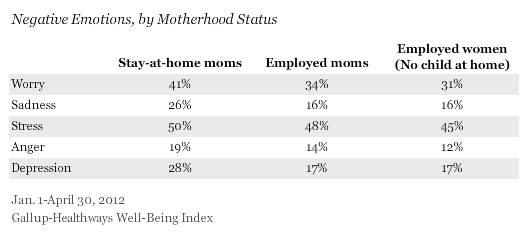
Among the most interesting findings is that stay-at-home moms reported higher rates of worry, sadness and depressed emotions than their employed counterparts (both with and without children).
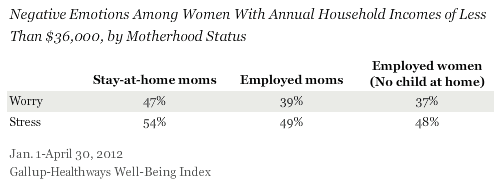

This varies by income level, with mothers in households that earn less than $36,000 annually expressing higher rates of worry and stress than their employed peers.

My take away is not that being a stay-at-home mother is intrinsically bad for your mental health. Rather, it may be that the stressors associated with being a stay-at-home mother are such (for some women) that their mental health suffers in comparison to their employed peers. These stressors are likely complicated phenomena with a diverse range of etiologies. Unfortunately, the Gallup report does not go into any follow-up questions that were asked, so we aren’t given a good picture as to why women felt this way.

A couple caveats – these are self reported mental health evaluations, not evaluations by mental health professionals. They are also only descriptive statistics, with no included difference of mean measures or the like. Gallup reports that these data are drawn from a sample n of 60,000 and have a maximum margin of sampling error of +/- 1% (95% confidence).
The continuing presidential campaign in the United States has been dominated by a number of noticeable trends, including contentious debates about reproductive rights specifically (what some have called the “war on women“) and, more broadly, about gender roles in American society (think about the recent commentary on Ann Romney, a topic Adia has blogged about). There has also been much discussion about the state of the economy in the United States and continuing issues of un- and under-employment (see my posts here and here).

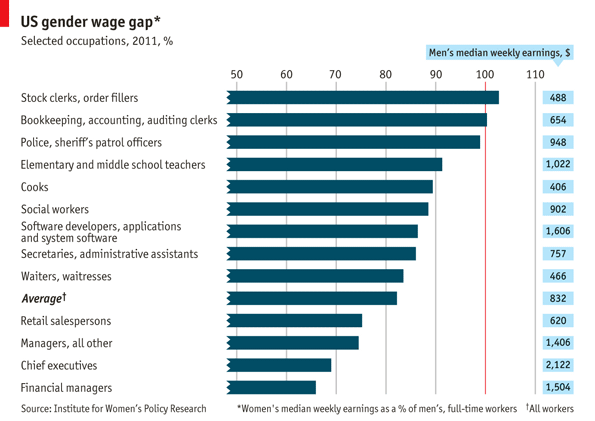
An important intersection of these two political debates is the counting disparity in pay by gender. A recent article in The Economist, citing work done by the Institute for Women’s Policy Research, documented this phenomena, noting that women continue to earn, on average, 82.2% of what men earn. This gap, as the graphic below shows, varies considerably by occupational category.

Image via The Economist (April 17, 2012)

In the following three pieces, our regular bloggers Adia Harvey Wingfield and Julie Kmec join guest blogger Rebecca Glauber in dissecting some of the causes and debates surrounding the gender wage gap, both within and outside of sociology.

I’ve been using a lot of air quotes in my classroom discussions, and I’m finding it a bit troubling. Not just because the quotes date me to the late 1990s, but also because they are inadequate stand-ins for something that needs to be said. Those gestures you make by your ears that slip out with little warning, shooting up from your hip mid-sentence as if to add irony, complexity, and intrigue. Women’s and men’s “choices” in work. Women’s and men’s “choices” in family.

Read More

A recent WSJ article by Kay Hymowitz (Why Women Make less than Men, April 26, 2012 ) reports that “most people have heard that full-time working American women earn only 77 cents for every dollar earned by men. Yet these numbers don’t take into account the actual number of hours worked. And it turns out that women work fewer hours than men.” Hymowitz continues, citing Labor Department statistics indicating more than half (almost 55%) of workers who work more than 35 hours per week (what the department defines as full time work) are men and suggests that the sex wage gap is “to a considerable degree a gender-hours gap.”

Read More

Julie and Rebecca have cited important sociological analysis that documents the fact that net of hours worked, the gender wage gap remains such that men still outearn their female peers in the same occupations. One other piece of commonsense wisdom often cited to explain the wage gap is the argument that women select occupations that tend to be lower paying—teaching, nursing, and other positions that we tend to associate with women. According to this line of reasoning, women are more likely to self-select into the “feminized” positions within certain fields, which then contributes to gender inequality in the labor market.

Read More

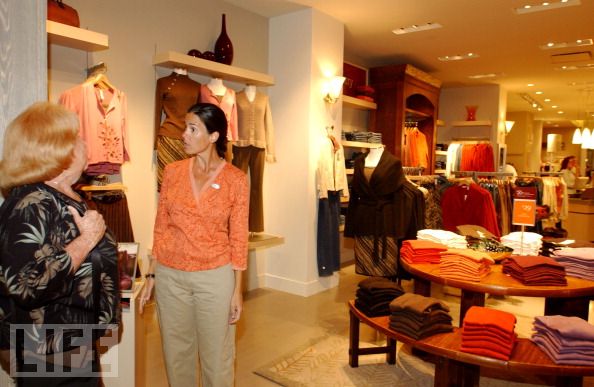
J. Jill employee via Life Magazine

I’ve started to notice more “help wanted” signs in retail stores.  Does this mean that the economy is recovering?  People may be shopping more, and stores may be hiring more.  But retail jobs will never improve this economy unless retail jobs are improved.

In this industry, full-time schedules are rare—most people are hired on a temporary and part-time basis—and pay is slightly more than minimum wage.  These jobs offer neither benefits nor opportunities for advancement.  Although many stores advertise “flexible” schedules, hours are worked only “as needed,” with schedules and hours shifting from one week to the next with little advance warning.  Workers cannot support themselves on the wages from these jobs.

Read More

Media has an immense power to both reflect the society it is a product of and initiate social change. For these reasons, it is often an effective tool for illustrating particular social concepts. The blog Sociological Images frequently uses visual imagery to illustrate a host of sociological concepts in an exceptionally compelling way. In a pair of posts today, Rachael Gorab and Adia Harvey Wingfield discuss the recent Academy Award Winning film The Help in terms of its portrayal of both race and gender in the world of domestic service work. For those of you who haven’t seen it, we’ve embedded the trailer to the film above. We hope you enjoy our latest panel!