Andras Tilcsik is a Ph.D. candidate in Organizational Behavior at Harvard University. His paper, “Pride and Prejudice: Employment Discrimination against Openly Gay Men in the United States” won the 2011 James D. Thompson Award from the Organizations, Occupations, and Work section of the American Sociological Association and was recently published in the American Journal of Sociology. The following (after the jump) is the text of an interview recently conducted with Andras by Rachel Gorab, a Ph.D. student in the sociology program at Northeastern University.
Good News for American Jobs? The Devil is in the Details
Last week saw the release of monthly employment data by the Labor Department. At face value, the overall news was good – the unemployment rate in the United States, at approximately 8.6%, is at its lowest projected level in years. However, as a recent op-ed in The Economist noted, the state of the union remains dire. Much of the malaise can be felt within the ostensibly improving American job market, where in spite of some good news there are plenty of reasons to remain cautious.
Not Working It: Race and Gender Stereotypes in Entertainment Media
2012 OOW Section Awards
It’s that time of year again! The Organizations, Occupations and Work section is now collecting submissions for its awards categories, which you can learn more about here and check out our past winners. Submission criteria and contact information for the current committees is available after the jump.
Seen Combat. Need Work.
Mt. Rainer Park in Washington was recently closed while the FBI investigated the fatal shooting of a park ranger and death of the gunman, probably from exposure. I could write about an almost two-year old law allowing people to bring loaded weapons into national parks or the untimely death of a young park worker, but I think it is salient to focus on what the media have already called to our attention: the alleged gunman is a veteran of the Iraqi war. After serving in Iraq for two years, reports from those who knew him say he was depressed, aggressive, and most likely suffered from PTSD once back in the U.S. Although I do not know if he was employed at the time of this tragedy, what occurred in Mt. Rainer should remind us of the economic plight of combat veterans.
Warehouses: The New American Sweatshop
Warehouse work, hidden by its very nature from the view of the general public, is increasingly a low wage job. Dave Jamieson, a reporter for the Huffington Post recently wrote an excellent piece on working conditions inside U.S. warehouses http://www.huffingtonpost.com/2011/12/20/new-blue-collar-temp-warehouses_n_1158490.html. While his discoveries about piece rate systems and subcontracting are not new, he shows how the industry has significantly changed in the last decade. The article reminded me a lot of my early work on the garment industry in Los Angeles, where mostly Asian and Latina workers toiled in sweatshops. It has become clear that warehouse work for corporations such as Wal-Mart, Target, and Amazon are examples of the new American sweatshop. Read More
2012 for the OOW blog
Happy new year from the OOW blog team. We took a little break over the holidays, but now we are back. We’ve got two posts coming up this week – one from Carolina Bank Muñoz on warehouse work and another from Julie Kmec on employment for veterans – and much more to follow in the coming weeks and months.
To briefly recap 2011 for the blog: Our first posts were on October 12, 2011. In our first three months, we managed 32 posts, which received over 7,200 views. We are quite happy with that. This year we hope to get even more analysis and commentary from a wider range of sociologists and, of course, we hope that there will be many more readers beyond the academy who find the blog useful.
If you are a general reader, then please feel free to contact us about issues you would like to us to cover. If you are a sociologist, please contact us if you have any ideas for topics to write on.
Here’s to a new year, which will hopefully bring more sociological analysis to mainstream discourse.
Best,
Matt, Steve, Chris and Adia
A Panel on Aesthetic Labor
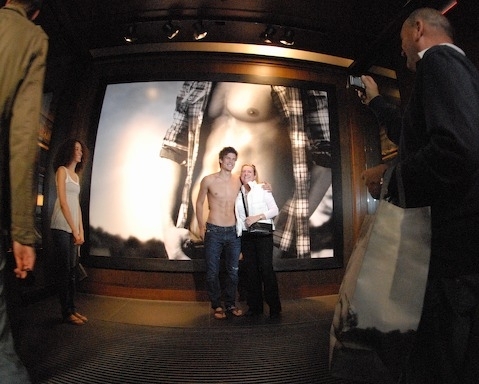
Photo via Improv Everywhere
The photo above, of an Abercrombie model posing with customers, embodies the sociological concept of aesthetic labor. Sociologists have been particularly interested in this phenomenon, which is the inclusion of an employee’s ‘look’ or ‘feel’ into the workplace. In many places, including some elements of the retail industry and the modeling industry, being a good or desirable employee is defined not just by the skill with which work is done, but also by the aesthetic qualities of employee.
We are posting a three part commentary today discussing the phenomenon of aesthetic labor. The initial post by Ashley Mears describes her work as a model in New York City’s fashion industry. The second post, by Emily Cummins, describes aesthetic labor, gender and the wedding industry. Finally, we are pleased to feature some commentary by Jeff Sallaz on the concept of aesthetic labor itself.
Will Work for Cool
Photo via Abercrombie & Fitch
Because it’s an exciting moment in fieldwork methods, I tell the story often of how I entered my research site for my new book, Pricing Beauty: The Making of a Fashion Model. My first year in graduate school, I was approached by a model scout in a coffee shop in Manhattan, who lauded my “look” and potential to make it big as a fashion model. This scout opened a narrow window of opportunity through which I gained entry as a working model at an agency in New York, and later in London, where I would spend 2 ½ years observing the market from the inside. That was one fortuitous cup of coffee. Read More
Labor and the Bride
Photo via Wikipedia.org
Women choosing bridal gowns (with the help of friends or stylists, even) probably isn’t new per se, but what does seem new, however, is the multitude of people who expend a not insignificant amount of labor creating the modern bride. And what’s worse, we can now watch it all unfold in television.