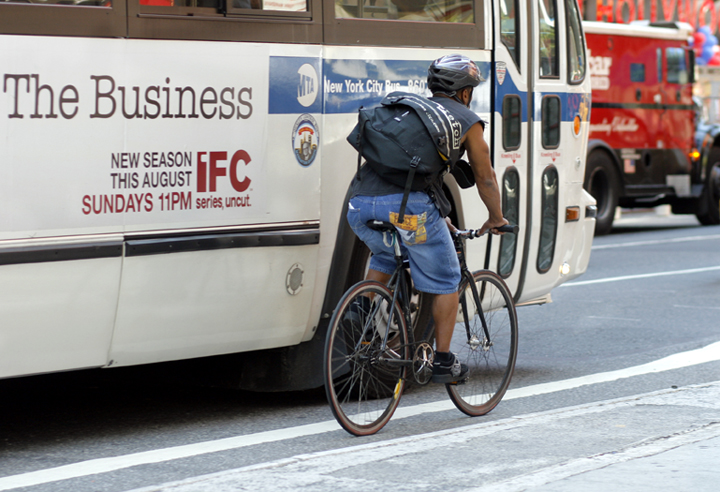
Photo via Improv Everywhere

This response is posted on behalf of Jeff Sallaz.

The idea of aesthetic labor is a fascinating one.  What does it mean to get paid to create beauty?  A beautician by definition engages in aesthetic labor, but so too does an avante-garde film-maker.  Are we justified to compare what happens in a hair salon with what occurs in a movie studio?   In both cases we find work that is extremely difficult to routinize or mechanize.  (Are you a Flowbee user?  Nuff said.)  And in both cases we find that acts of production and consumption are united in a way that complicates Marx’s notion of commodity fetishism (witness the cult of the auteur).

Read More

A recent New York Times article reports on how the long downturn of the US economy has hit the public sector hard, which, in turn, has been devastating for the black middle class. The article notes that black workers are about one third more likely than whites to be employed in the public sector. Blacks have historically been more able to find work in the public sector, as they faced more discrimination in the private sector. Overall, unemployment rates for blacks have consistently been about twice that for whites, with the black unemployment rate peaking at 16.7% last summer.

The article provides important reporting, but it is unfortunate that it only cites economists and does not address sociological contributions to understanding racial discrimination in labor markets. It notes that economists explain the persistent racial gap in terms of lower educational levels for blacks (the standard human capital refrain), along with continuing discrimination.

Read More

In a recent article on TomDispatch.com, Andy Kroll documents some real changes that have resulted from the OccupyUSA movement. To begin with, the Occupy movement has changed the political discourse. Research by Politico shows that “Mentions of the phrase ‘income inequality’ in print publications, web stories, and broadcast transcripts spiked from 91 times a week in early September to nearly 500 in late October.”

But the effects have not been limited to discourse. As Kroll argues, based on his own journalistic research in Ohio, the OWS movement was instrumental in generating support for the referendum that voted down governor John Kasich’s anti-union law, which would have severely limited the collective bargaining rights of 350,000 public workers.

The anti-union bill had been reframed in terms of the language of the 99%. According to many organizers Kroll spoke with, the heightened sensitivity to income inequality and the energy of the Occupy movement were critical for building support to defeat the bill. Read Kroll’s article here.

Photo: Keri Wiginton

We are posting a three part panel today discussing the concept of edgework, a term used by sociologists to describe activities that involve an element of risk. The initial post by Jeffrey L. Kidder describes his research on bike messengers and his thoughts on work in dangerous or risky situations. We also are pleased to feature two responses to Jeff’s post. Jen Lois, who has researched wilderness search and rescue volunteers, and Ben Fincham, who has also researched bike messengers, both offer their thoughts on edgework and Jeff’s piece. Enjoy!

Photo: Keri Wiginton

On paper, bike messengering represents the very worst of post-industrial employment.  The work is physically demanding and it pays very little.  For around $100 a day (sometimes more, often times less) messengers must careen through gridlocked traffic, breaking traffic laws, and risking their own safety in order to deliver the advertising proofs, architectural blueprints, and legal documents that circulate in the downtown cores of major cities.  Injuries are common; workers compensation and medical coverage are rare.

Read More

Jeff’s piece is a very interesting post, and I’m particularly intrigued by two ideas. The first is that edgework and paid work can be integrated and accomplished in the same act. Typically we have seen edgework conceptualized as leisure, which implies a sequential relationship with paid work: spend all day at work becoming alienated and then pursue edgework to recapture an authentic sense of self. That bike messengering provides a way to seek authenticity through paid work is a novel angle, and the question this raises for me is how does that happen? What is it about integrating edgework with paid work that allows for such a powerful experience of authenticity? Is this experience different from the “sequenced” version of edgework, where the self alternates between work (alienation) and leisure (authenticity)?

Read More

by Ben Fincham

Like Jeffrey Kidder I spent some time studying the bicycle messenger industry. In contrast to him I examined the European context and undertook an ethnography in the UK – working as a messenger for a couple of years – as well as interviewing messengers across Europe and conducting a European quantitative survey. As such I was interested in this article particularly as many key features of bicycle messengering appear to me to be present in both the United States and in Europe.

My experiences – a decade old now – were marked by low pay and a hazardous working environment. My colleagues, several of whom are still friends, were an eclectic mix of middle class idealists, cycling enthusiasts, people that had difficulty finding regular employment and a few people that seemed to revel in the performance of bicycle messengering and all that this entailed.

Read More

In April I participated in the union assembly of Wal-Mart warehouse workers in Santiago, Chile. When I was invited to the meeting I thought to myself “how many workers are really going to come to a meeting on a Sunday morning at 9am.” Much to my surprise, the union had rented a theatre. Of the 1500 warehouse workers in Santiago, 1200 showed up that morning. I was blown away.

Wal-Mart workers in Chile are overwhelmingly unionized. This is in stark contrast to the U.S. situation where workers who have been trying to unionize have been shut down time and again with Wal-Mart’s aggressive anti-union tactics.

Read More

It’s been just over one month since we launched oowsection.org and we’re tremendously happy with the response to the blog so far. We hope that you, our readers, have enjoyed reading the posts as much as we have. We’d like to take a moment to share with you some of the ways that you can participate with us in on our blog.

1. Follow Us
When we launched last month, we simultaneously opened a Twitter account (@Orgs_Occs_Work) to help get the word out about our posts. Since then, we have added a Facebook page as well as the ability to subscribe to oowsection.org via email. If you subscribe, you’ll receive an email every time a new post goes up. We’re also announcing new posts on Twitter and Facebook, as well as sharing links to new stories and other articles. Finally, you can follow us via RSS feed through Google Reader or the RSS reader of your choice. You can find links to all four of these options on the righthand sidebar of our blog. Please follow us on Twitter and like us on Facebook!

2. Comment
At the bottom of each post, you will find a place to leave a comment on the post. You may leave comments for us or respond to other commenters. Commenting gives you the chance to respond to our authors and others, and continue the discussion that we’re contributing to. The more you participate, the better the conversation!

3. Share
At the bottom of each post, you will find links that allow you to re-blog us easily on WordPress and to email copies of our posts to others who you think may find us interesting.

We’ve also made it easy for you to share our posts across a variety of social media platforms. Included are the standard social media services (Facebook, Twitter, and Google+) as well as a number of services designed for sharing blog posts and news articles (Stumbleupon, Reddit, and Digg). Share us widely and often!

4. Write
We welcome all members of our community to submit story ideas to our editorial team. Get in touch with any of us to share your thoughts and propose a story!
With the new TV show, Pan Am, having been picked up by ABC and BBC2, a recent Guardian article reports on the sexism that continues to face female flight attendants — something that has persisted and been encouraged by airline management, from the 1960s through to today.

The article extensively quotes sociologist Bev Skegg of Goldsmiths university and author of the book Formations of Class and Gender. The article also discusses the sociological concept of aesthetic labor, which it usefully defines as “when employees’ feelings and appearance are turned into commodities.”

Read More